Showing posts with label prayer. Show all posts

Thursday, October 24, 2013

“Giving up the Art of Laughter?”: Isaac, After the Akeidah


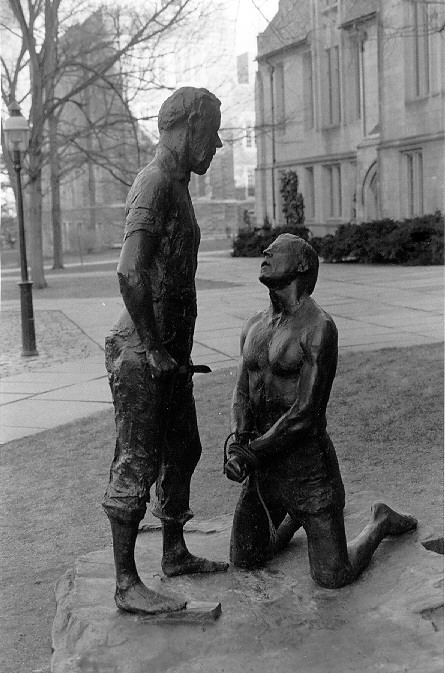
George Segal, Avraham offering his son Isaac, 1973
After the Akeidah. Is there such a thing? “No poetry after Auschwitz,” said Adorno - would Isaac agree?
This week’s Torah portion focuses on the finding of a wife for Isaac, but he is barely mentioned in the process, inviting us to consider Isaac’s life after the Akeidah.
The truth is that Isaac is the blandest of the Patriarchs. The Biblical spotlight barely focuses on him. He seems to always play the supporting cast to his father/wife/neighbors/twin sons. Someone else is sent to find him a wife, he spends his life digging his father’s wells only to have them blocked or stolen by others, and finally gets tricked by his son in his old age.  Perhaps Adorno is right, and Issac’s life is to be understood as the poetry-less life of a survivor of patricide (interestingly, his son Jacob describes God as “the God of Avraham and the Fear of Isaac” Gen 31:42).
Elie Wiesel however presents a different take, focusing on the things which we might take for granted about Isaac:
 Isaac survived. He had no choice. He had to make something of his memories, his experience, in order to force us to hope. Isaac represents defiance. He defied death. Logically, he should have pursued oblivion. Instead he settled on his land, married, had children, refusing to let fate turn him into a bitter man.
He felt neither hatred nor anger toward his contemporaries who did not share his experience. On the contrary, he liked them and showed concern for their well-being. After Moriah, he devoted his life and his right to immortality to the defense of his people. He will be entitled to say anything he likes to God, ask anything of Him.
Because he suffered? No. Suffering confers no privileges. Rather Isaac knew how to transform his suffering into prayer and love rather than into rancor and malediction. This is what gives him rights and powers no other man possesses.
And as the first survivor, he had to teach us, the future survivors of Jewish history, that it is possible to suffer and despair an entire lifetime and still not give up the art of laughter.  (Elie Wiesel, Messengers of God.  pg 92)

Isaac’s calling, according to Wiesel’s auto-biographical projection, is in transforming the most traumatic moment in his life into a resource for his community. He is to become an advocate on behalf of those who suffer in silence. Wiesel’s point highlights one of the rare moments in which Isaac takes agency. When Rebecca is barren, he prays on her behalf, turning “his suffering into prayer and love rather than into rancor and malediction”:
And Isaac entreated God in presence of his wife, because she was barren;
and God let Himself be entreated of him, and Rebekah his wife conceived. (Gen 25:21)
וַיֶּעְתַּר יִצְחָק לַיי לְנֹכַח אִשְׁתּוֹ, כִּי עֲקָרָה הִוא; וַיֵּעָתֶר לוֹ יי, וַתַּהַר רִבְקָה אִשְׁתּוֹ.
(בראשית כה:כא)

Isaac’s behavior puts his heroic father to shame. How come Avraham, in all those years of Sarah’s barrenness, never “entreated God in presence of his wife”? Returning to Wiesel’s words above, I wonder if this is in some way connected to the “Art of Laughter”, and the connection between knowing how to pray and knowing how to laugh. Prayer is indeed laughable, in the deepest sense. Both come across as the most primal of human responses, irrational and yet totally real. They are both actions that embody full presence-in-the-moment, seemingly not representing action, but actually offering a third way. Laughter and Prayer break the evolutionary psychologist’s dichotomy of “Fight or Flight”. Avraham knew how to fight, and he know how to run. But, perhaps, he didn’t know how to laugh.

Shabbat Shalom,
Mishael

P.S. Yehuda Amichai completely disagrees with Elie Wiesel in this poem:

Avraham had three sons, not just two
Avraham had three sons: Yishmael Yitzchak and Yivkeh.
No one has ever heard of Yivkeh, for he was the youngest
And the most beloved, who was sacrificed on Har Hamoriah.
Yishmael was saved by his mother, Hagar; Yitzchak saved by the angel.
But Yivkeh was not saved by anyone. When he was young,
His father would call him, in love, Yivkeh, Yivk, little Yevk
My sweetie. But he sacrificed him in the Akedah.
And in the Torah it says a ram, but it was Yivkeh.
Yishmael never again heard about God, the rest of his life.
Yitzchak never again laughed, the rest of his life.
And Sarah only laughed once, and never again.
Avraham had three sons,
Yishma, Yitzchak, Yivkeh
Yishmael, Yitzchakel, Yivke-el.
Yehuda Amichai 


Thursday, September 12, 2013

“When they said Repent, I Wonder what they Meant": An Alternative Playlist for Yom Kippur

One of Jewish music’s most venerable traditions is that of borrowing love songs from popular culture and re-positioning them in a religious context. Yisrael Najara took Turkish love songs from the alleys of Damascus and Gaza and set them to holy words. Yehuda haLevi borrowed the imagery of Saharan shepherds and used them to describe the longing of the forsaken Jewish people. It is told of Rabbi Ovadiya Yosef that he can only write his halakhic responsa if Umm Kulthum is playing in the background. All is fair when trying to open up the heart…

As Yom Kippur comes round the bend each year, I find myself searching for an alternative playlist of songs to supplement the traditional ones, hoping to crack open my cynical heart with a surprising connection or two. As a gift for the new year, here is my list this year. While a random selection at best, it seems each song includes its own answer to Leonard Cohen’s immutable question:

Pay Me or Go to Jail!
Bruce Springsteen | Pay Me My Money Down

“Repentance” is the Latin term often used for the Hebrew word “Teshuva”. They actually mean vastly different things. In the metaphor of repentance, atonement is achieved by paying back. Our sins are debts, accrued throughout year. As the New Year approaches, our debtor demands of us: “Pay me my money down!” On Yom Kippur – unable to repay all our bad deeds – we admit bankruptcy and request a bailout from the powers that be: another year of life.

I'll find my way back to you / If you'll be waiting
 “Teshuva” on the other hand, means returning. It has nothing to do with the financial – it is wholly spatial. Sin is distance – from truth, from God, from ourselves. The distance is understandable; a logical outcome of a year of journeys. What is required now is a return. Luckily the Jewish people have a promise: No matter where they leave to, God will be waiting for their return. Tracy Chapman promises the same, and her words could easily be a stand-in for a Later Prophet or a Medieval Spanish Jewish poet singing about God and the Jewish people, recalling that old love affair one more time…

If you go, who will embrace me like that?
Yom Kippur is the day of closeness, the day in which the High Priest enters the innermost sanctum, the most intimate place in the Temple. Yet the moments of intimacy also raise the anxiety – what happens if you leave? How will I handle being alone again? We recall what happened with the Temple in the end… The Israeli Idan Raichel memorialized this felling most poignantly in his Hebrew song, “Im Telech - If you go”:
If you go / who will hug me like that / who will me hear at the end of the day
who will comfort and soothe / only you know.
In our new “theological” context, one can wonder: who has a deeper anxiety about being left alone – man or God? Rationalists might not like that questions, but Kabbalists, Hasidim and Heschelians have been asking it for years…

My Entire Body: Take One
A moment before Kol Nidrei, Sephardic Jews will recite an erotic poem of deep desire: “To You My God, is My Desire” by Avraham Ibn Ezra.:
To you my God is my desire / in you is my pleasure and my love
to you is my heart and my kidneys / to you is my spirit and my soul
One by one they will mention each of their limbs and organs, reiterating how much they all aspire, desire and long for God’s proximity.
At the same time, traditional Ashkenazi Jews will also be mumbling about their limbs and organs. But in the Ashkenazi version, called “Tefillah Zakah”, it is to decry how each limb has sinned this year, how each organ has betrayed the Lord. Of these two alternatives, despite my European roots, the Sephardic embrace of life and desire is the gate through which I hope to enter Yom Kippur this year.

My Entire Body: Take Two
Here is a third alternative, rebellious and heretical, but life affirming in a way that is reminiscent of the lust for life of the High Holiday poetry. In Nina Simone’s version of this “Hair” classic, there is a deep spirituality to the freedom of the body. Some might find that freedom in a release from religion. I find it by reclaiming the divine roots of life, seeking freedom from the way society and corporations try to define my body for me. Either way, the cry of life is the basic cry of Yom Kippur: “I’ve Got Life!”, “Seal us in the Book of Life!”

May we be sealed in the Book of Life,

Mishael