Showing posts with label thanksgiving. Show all posts

Monday, November 4, 2013

A Thanksgivukkah Manifesto

Rabbi Mishael Zion | Bronfman Fellowships | Text and the City | Thanksgiving 2013


Buzzfeed

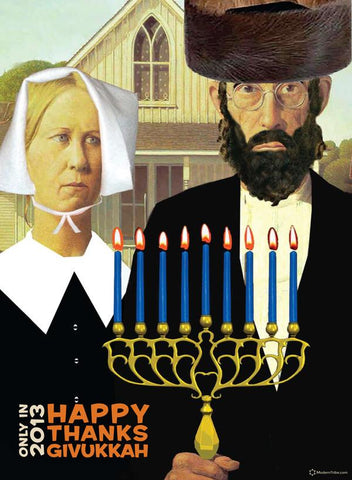
A once in a century holiday is upon us. The menurkey will soon sit at the table with the pumpkin pie and the latkes. Let us not underestimate this moment for the American Jewish community. Thanksgivukkah is here. 

Jews have always loved Thanksgiving. Now that their favorite American holiday finds itself face to face with America’s favorite Jewish holiday – Hanukkah – the encounter can say an enormous amount about the American Jewish collective story. In other words, Thanksgivukkah tells us something important about what Jews are doing in America.

It starts with good timing. When Hanukkah falls on Christmas, it highlights Judaism as a religion, a fair contender on the scene of American denominations. But Thanksgivukkah yanks the carpet from under the convenient Christmas-Hanukkah dichotomy.

The Thanksgiving of today grew out of its religious roots. The same could be said of the Judaism of many Americans. Thanksgiving is about America, not in a celebration of patriotic triumphalism. It’s about America as a promise, an idea, a project. If, any other year, most American Jews sideline Judaism and celebrate Thanksgiving simply as Americans, this year’s calendar demands owning up to the Jewish take on the American story.

In Thanksgivukkah this generation of Jews might just have found their model holiday.

Indeed, if there is an “American Project”, Jews have been some of its most avid contributors. As narrators, critics, troubadours and activists, they took care of themselves while making plenty of room for others. To be sure, America is far from the only contemporary Jewish story. Jews have not one, but two Promised Lands: Israel and America have become the yin and yang of the Jewish people. As Hillel might have put it: “If I am not for myself – who will be for me?” – such is the Israeli project. “And if I am only for myself, what am I?” – the American Jewish project.

“And if not now, when?”

Thanksgivukkah brings home some of the challenges of a Jewry so invested in America. For the most part, American Judaism has failed at being a homemade identity, outsourcing the task to synagogues, Hebrew schools, Bnai Brith or AIPAC. Yet Hanukkah leaves the synagogues orphaned. With all due respect to public square Menorahs, any halakhist will tell you it’s the Menorah in the home that counts. Thanksgiving is the same: it is a homemade celebration of Americanism; it convenes the family in a feast of gratitude. Pilgrimages by air, track and road attest to the home’s centrality.

Thanksgiving is a much needed model for an increasingly secular American Jewry. Where “cultural Judaism” is often “soft” and “optional”, Thanksgiving has an undeniably “commanding” presence. Who doesn’t come home for Thanksgiving, from wherever that may be? Who doesn’t have a turkey at the table, even if it’s made of tofu? Thanksgiving is an unapologetic model for a cultural identity being a commanding presence in one’s life.

But Hanukkah one-ups Thanksgiving - it turns family time into story time. When asking where the Bible commanded us to light the Hanukkah candles, the Talmud responds: “We learn that we must light candles from the Biblical verse: ‘Ask your father, he will tell you’.” The candles set the stage for a story.

Buzzfeed's delicious Thanksgivukkah Table
Yet in those rare moments where a family Thanksgiving allows for a discussion, it is often of a “here and now” gratitude. Hanukkah’s gratitude, on the other hand, is rooted. A Thanksgiving-style family meal with Hanukkah-style stories ask us to place the individual narrative on a longer trajectory — why did we come here, how did we achieve the things for which we are grateful, and where do we - individuals, community and country - go from here. That is what Thanksgivukkah should be. It should turn a generation of immediate gratification into one of rooted gratitude. It’s not about religion or musty history, but about the power of local family stories. America and Judaism each face severe struggles adapting to a flat world. Both are undermined by an increasingly divided base. They need their stories more than ever. Ask your mother; she will tell you.

For an American Jewish community increasingly consisting of families of both Jewish and non-Jewish members, Thanksgivukkah is a moment that allows for a diversity of stories at the table. Hanukkah’s Jewish coat over Thanksgiving’s American jersey throws us back to the vision of America as a series of cultural pluralisms. Thanksgivukkah asks us to keep telling the stories that go beyond America.

Thanksgivukkah is an invitation to celebrate the places where Jewishness enriches America, and where America enriches the Jewish people. Jews have always preferred stories to dogma and ritual to creed. This November American Jews are invited to sit down at the Thanksgivukkah table and tell stories of rooted gratitude. Let's make sure this happens more than just every 70,000 years. Happy Thanksgivukkah.

For further discussion of these ideas, including ideas for family Thanksgivukkah conversations, and links to other Thanksgivukkah resources, visit Text and the City.


At the Thanksgivukkah Table: Stories, Rituals and Conversations

Following the ideas in my Thanksgivukkah Manifesto, here are some suggestions for conversations, rituals and activities for Thanksgivukkah night. I’d love to hear your suggestions and ideas – you can reach me at mishzion @ gmail com, or just leave a comment on this post.

Spark Conversations:
It isn't Passover, I have few illusions of getting into anything to elaborate. But a few pointed questions can get a good conversation going, even with the football in the background…
  • The juxtaposition of Christmas and Hanukkah is so strong in our minds and has served as a crucial part of American Jewish identity building. What “happens” when Hanukkah is juxtaposed with Thanksgiving? What similarities and tensions does this raise? What does it mean for Judaism in America?
  • Thanksgiving is an opportunity to take stock of the “American Project”. How are we doing? Where does your own story fit into this idea? What are the ways we dedicate energy and resources to bettering this country and furthering this project? And what is the role of criticism and counterculture in this project?
  •           The fantastic folks at Ask Big Questions put together a conversation guide for asking "What are you Thankful for" Use it with your family at Thanksgiving. Get a group of friends together around the fireplace during the long weekend. Or invite your neighbors from down the hall or around the block for a living room conversation.
  • If Thanksgiving was a Jewish holiday, how would it look different? What laws, rituals or prayers would it have?
  • Many of us struggle with Thanksgiving’s founding myths – the relationship to the Indians, the unclear religious roots. The same if often true of Jewish founding myths. What lessons can we learn from these various struggles?


Tell Stories:
Families tell stories in many ways, not just the overt “once upon a time”. Thankgivukkah is a powerful opportunity to unearth some of those family stories. Some stories to look out for:
  •           Have someone share a story of a first Thanksgiving in America – from an immigrant or an older participant; or try and research your family’s earliest Thanksgivings…
  •           Of the various ethnicities or families around the table, what has been the path to Americanness of each family, and what “additional” identities continue to play out in America?
  •           Participate in StoryCorps’ National Day of Listening (http://nationaldayoflistening.org/) 
  •           Hanukkah is the holiday of Jewish heroes – from the Maccabees to Bella Abzug, a great Jewish American heroine. What “heroes” do you recall on Thanksgivukkah?


Invent Rituals:

What else? Let us know and we'll feature it here!


Wednesday, November 23, 2011


The Art of Parenting: Being the Mother of both Yaakov and Esav
Parashat Toldot | Heshvan 5772 | November 2011

It is rare to gain insight into who our parents are as parents. A holiday visit after a long period apart might raise that moment of realization: Oh, so that’s the kind of parent my mother is! Observing how my parents act with my children has raised the same understanding: So that’s what my dad was like… The insights about our parents often become insights about ourselves: I guess that’s why I am so…
Of all the mothers of Bereishit, I find Rivkah to be the most fascinating, as a person and as a parent. Ambitious, tough, smarter than you, Rivkah is unique in the bible: she is a real go-getter. We are introduced to her watering a stranger’s ten camels, in an act that will land her a wealthy husband. After years of barrenness, when she experiences a severely painful and debilitating pregnancy with twins, she becomes the first seeker of existential meaning:
Rivkah became pregnant.
But the children almost crushed one another inside her,
so she said: If this be so, why do I exist?
And she went to demand God. (Genesis 25:22)
וַיִּתְרֹצְצוּ הַבָּנִים, בְּקִרְבָּהּ,
וַתֹּאמֶר: אִם-כֵּן, לָמָּה זֶּה אָנֹכִי?!
וַתֵּלֶךְ, לִדְרֹשׁ אֶת  ה'.  (בראשית כה:כב)
Rivka’s strategic thinking comes to the fore in this week’s parsha when she pushes her preferred son, Yaakov, to steal his brother’s blessing. It is a troubling ethical moment, but also a fascinating parental moment. Rivka is not only favoring one son over the other, but she is pushing her chosen son beyond his comfort zone. She is so certain in her acts that she takes responsibility for any consequences as she ignores his strong objections:
Yaakov said to Rivka his mother: …
I will be like a trickster in his eyes,
and I will bring a curse and not a blessing on myself!
His mother said to him:
Let your curse be on me, my son!
Only: listen to my voice and go… (Genesis 27:11-13)
וַיֹּאמֶר יַעֲקֹב, אֶל-רִבְקָה אִמּוֹ...
וְהָיִיתִי בְעֵינָיו כִּמְתַעְתֵּעַ; וְהֵבֵאתִי עָלַי קְלָלָה, וְלֹא בְרָכָה.
 וַתֹּאמֶר לוֹ אִמּוֹ: עָלַי קִלְלָתְךָ בְּנִי;
אַךְ שְׁמַע בְּקֹלִי, וְלֵךְ קַח-לִי.
(בראשית כז:יא-יג)
In trying to imagine how Rivka convinced Yaakov to do this (and how she convinced herself of the legitimacy of her actions), I hear a different mother’s voice. Langston Hughes’ 1922 poem, of a Harlem mom prodding her son to keep climbing up the social ladder, could easily be put into Rivka’s mouth:
Mother to Son | Langston Hughes

Well, son, I’ll tell you:
Life for me ain’t been no crystal stair.
It’s had tacks in it,
And splinters,
And boards torn up,
And places with no carpet on the floor—
Bare.
But all the time
I’se been a-climbin’ on,
And reachin’ landin’s,
And turnin’ corners,
And sometimes goin’ in the dark
Where there ain’t been no light.
So boy, don’t you turn back.
Don’t you set down on the steps
’Cause you finds it’s kinder hard.
Don’t you fall now—
For I’se still goin’, honey,
I’se still climbin’,
And life for me ain’t been no crystal stair.

Rivkah has worked hard to get to this moment. She walked through splinters to get out of Lavan’s house, out of the darkness of Avimelech’s grasp, and out of the clasp of barrenness. She will not see her life’s destiny (“why do I exist?”) become lost to an older son who has chosen the wrong path in her eyes, or a younger son who does not grab his destiny like his mother did. She wants her travails to be about something, and the way she’s going to make that happen is through her son Yaakov, even at the cost of thrusting him into a dark corner of his own. Rivkah is a tribute to those many parents who pushed their children to demand more from life, sometimes even at the risk of losing their own authenticity, but hopefully to the benefit of the world at large.
Allow me one more twist: In the last mention of Rivka in the parsha, the Torah gives a tiny hint that opens up an entirely untold episode of Rivka’s parenting. As Yaakov leaves for Lavan’s house, the text describes Rivkah in unique terms:
 [Yaakov] went to the country of Aram,
to Lavan the son of Betuel the Aramean,
the brother of Rivka, the mother of Yaakov and Esav.
(Genesis 28:5)
וַיֵּלֶךְ פַּדֶּנָה אֲרָם
אֶל-לָבָן בֶּן-בְּתוּאֵל, הָאֲרַמִּי,
אֲחִי רִבְקָה, אֵם יַעֲקֹב וְעֵשָׂו.
(בראשית כח:ה)
This last description, “Rivkah, mother of Yaakov and Esav” throws all the close bible readers off. Who needs this extra piece of biographical information here? As Rashi puts it, in a rare moment of interpretive befuddlement: איני יודע מה מלמדנו”I do not know what it teaches us.”
Nechama Leibovitz, in her ever inspiring essays on the parsha, answers Rashi’s query by suggesting that the text is opening up a window to Rivka as the parent of Esav as well, not just Yaakov’s doting mom. One wonders – what are the missing episodes of Rivka’s parenting that this verse is alluding to? How many pep talks did Rivka offer to Esav, how often did she give him a Langston Hughes’ style motivational?
Perhaps even at the very moment when she is preferring one son over the other, she is doing that as a parent of both, not only one. Rivkah reminds us that choosing to throw your lot in with one destiny does not mean that your complex ties with the alternative destiny must necessarily be severed (as my teacher Rav David Bigman once said, about a different parenting dilemma: “The tragedy of the Israeli-Palestinian conflict is that God’s two children are warring with eachother. What is he going to do?”). Even when faced with the toughest of choices, we are also at some level the mother of both options, Yaakov and Esav …
The story of Rivka shines a light on the complicated art of parenting: How much we push our own agendas and stories onto our children’s lives, and how much we are living the lives our parents have pushed us to live. It is easy to call for authenticity above all else, but the truth is that there are times when shoving a hairy coat in your child’s face is exactly the right move, and then there are times when living your parents’ dreams would be an act of tragic blindness. Perhaps Yaakov would have been best served if Rivka would have taught him to ask for himself her question: “If this be so, why do I exist?” But then again maybe he needed to be pushed into his brother’s blessing and out to his uncle’s home in order to reach the point where he could start his own existential journey. Through those dilemmas, there’s an element of thankfulness to those people who walked the tightrope of those decisions, raising us and being parents to both the Yaakov and the Esav within us.

Shabbat Shalom,
Mishael


A special thank you to Rachel Cohen (’05) who helped me sharpen the ideas here, and in many previous divrei torah.