Friday, April 25, 2014

Criticize Me! Creating a Healthy Culture of Rebuke


"If you treat a man as he ought to be and could be,
he will become what he ought to be and could be"
Goethe
A parlor game for the Biblically inclined: Of all the verses in the Torah, which is the commandment people fulfill most often? I’d put my money on this one:
הוֹכֵחַ תּוֹכִיחַ אֶת עֲמִיתֶךָ,
וְלֹא תִשָּׂא עָלָיו חֵטְא. 
Criticize, yes, criticize your fellow,
And you shall not bear sin because of him!
(Leviticus 19)

The action has many names: admonishment or feedback, advice or chastisement. Each verb reflects a different style and approach in the conveying of the same basic information (“you did X and that was a mistake”). What word would you use to describe the last time you criticized someone? Rebuke seems to be a favorite of Bible translators, although the more neutral “reproof” comes the closest to the Hebrew original – tochecha תוכחה, from the Hebrew word להוכיח – to prove; to make manifest.
What is clearly manifest is that criticism is too often a self-detonating mechanism. It is experienced as an attack – thus inviting a defensive response, or a counter attack… There is no speech act more quotidian and yet more treacherous then the conveying of criticism.
And yet there is nothing more crucial to a healthy society - or relationship - then a healthy culture of criticism. Getting this commandment right is crucial at home as in the workplace, in the trenches of social action as between friends. To use the language of our weekly portion, Kedoshim - which begins with the call to “Be Holy!” and continues to command us to “Rebuke, yes Rebuke!” – the path to a Holy Society passes through the Temple of Rebuke. But our text seeks to create a society which aspires not only to Holiness but also to Love. Our chapter, Leviticus 19, includes not only “Be Holy” but also “Love your Neighbor as yourself” among its top-ten. Indeed, for the Rabbis, rebuke is the very cornerstone of a loving relationship:

אמר ר' יוסי בר' חנינה: התוכחת מביאה לידי אהבה, "הוכח לחכם ויאהבך" (משלי ט ח), היא דעתיה דר' יוסי בר' חנינה דאמר: כל אהבה שאין עמה תוכחת אינה אהבה.
Rabbi Yose son of Rabbi Hanina said: Rebuke leads to love, as it says, “Rebuke a wise man, and he will love thee” (Proverbs 9:8). In addition he said: Love unaccompanied by rebuke is not love. (Beresihit Rabbah 54; 21:25)

So how is criticism done right? I’m still working on that one. In the meantime, I’ve found some good practical advice in the following sources:

Speak Sheep to Power
Nathan is faced with the challenge of a lifetime when he is commanded to make manifest to his King that he is not only an adulterer, but a murderer to boot. Facing King David, Nathan’s dilemma captures how painful the process of rebuke is. For at its core, rebuke is the tearing off of a mask of lies and deception which a person has told not only others, but himself.
Nathan’s solution is brilliant: I can’t rip this mask off his face, but he can…

1The Lord was displeased with what David had done, and the Lord sent Nathan to David. Nathan came to David and said, “There were two men in the same city, one rich and one poor. 2The rich man had very large flocks and herds, 3but the poor man had only one little ewe lamb that he had bought. He tended it and it grew up together with him and his children: it used to share his morsel of bread, drink from his cup, and nestle in his bosom; it was like a daughter to him. 4One day, a traveler came to the rich man, but he was loath to take anything from his own flocks or herds to prepare a meal for the guest who had come to him; so he took the poor man’s lamb and prepared it for the man who had come to him.”
5David flew into a rage against the man, and said to Nathan, “As the Lord lives, the man who did this deserves to die! 6He shall pay for the lamb four times over, because he did such a thing and showed no pity.” 7And Nathan said to David, “That man is you! […] 13David said to Nathan, “I stand guilty before God!” (Samuel II 12)
Nathan does not rebuke David, he sets up the situation so that David rebukes himself. He invites David to view himself from an external viewpoint, allowing him to recognize and admit his own guilt. Successful rebuke is the act of causing self-incrimination.

Speak of the Future, not the Past
Maimonides in his Code gives some practical advice on the setting in which successful criticism can be given:
He who rebukes another, whether for offenses against the rebuker himself or for sins against God, should administer the rebuke –
in private;
speak to the offender gently and tenderly;
and point out that he is only speaking for the wrongdoer's own good, to secure for him life in the world to come. (Maimonides’ Code, LAWS OF CHARACTER TRAITS 6:7)

Maimonides points out a few concerns: social setting (privacy, intimacy – avoiding public shaming); tone and timing (not to criticize as an immediate response or an emotional outburst, but in a methodical and opportune moment); and finally –creating an atmosphere of trust and genuine investment in the other’s wellbeing. Rebuke cannot be experienced as a gratuitous revisiting of yesterday’s actions (or the making of a theological stance about the afterlife). The motivation for criticism must be the desire to see the best possible future for the other.

Don’t Speak
There is a commandment to rebuke, but sometimes – if there is cause to believe that the rebuke will not achieve the desired effect – the correct fulfilling of the mitzvah of rebuke is to be silent.

אמר רבי אילעא משום ר' אלעזר בר' שמעון: כשם שמצוה על אדם לומר דבר הנשמע, כך מצוה על אדם שלא לומר דבר שאינו נשמע. רבי אבא אומר: חובה, שנאמר: "אל תוכח לץ פן ישנאך הוכח לחכם ויאהבך" (משלי ט:ח).
R. Ela’a in the name of R. Elazar son of R. Simeon said:  Just as one is commanded to say that which will be heard, so is one commanded not to say that which will not be heard.
R. Abba stated: It is a duty, for it is said in Scripture: "Rebuke not a scorner, lest he hate thee; Rebuke a wise man, and he will love you" (Proverbs 9:8). Talmud Bavli  Yevamot 65b
Figuring out when to rebuke and when to stay silent is perhaps the most challenging of all. For me this week’s portion invites a moment of introspection: those times in which it would be wise to be more sparing in fulfilling this commandment, and the time when my opting for peace and passivity turned into passive aggressiveness…  But perhaps the biggest piece of advice is not about giving rebuke, but about being a person who willingly accepts, even seeks, advice. As Sefer Haredim, a 16th century self-help guide for “Holier living” puts it:
"Remove the barriers from your heart" (Deut. 10:16) A person's heart must be soft and receptive, receiving the words of a reprover and not hating him, rather loving him more,  as the verse says: “Rebuke the wise one and he will love you” (Proverbs 9:8).

Finally, after teaching about rebuke a few years ago, someone gave me a wonderful gift. This poem by William Blake:

A Poison Tree

I was angry with my friend; 
I told my wrath, my wrath did end.
I was angry with my foe: 
I told it not, my wrath did grow. 

And I waterd it in fears,
Night & morning with my tears: 
And I sunned it with smiles,
And with soft deceitful wiles. 

And it grew both day and night. 
Till it bore an apple bright. 
And my foe beheld it shine,
And he knew that it was mine. 

And into my garden stole, 
When the night had veild the pole; 
In the morning glad I see; 
My foe outstretched beneath the tree.

Shabbat Shalom,

Mishael

Sunday, April 13, 2014

What we are talking about when we talk about Hametz


It never ceases to amaze, the all-out war on yeast declared each year by thousands of families. Whether it plays out as a complete eradication of all household dust - spring cleaning under the guise of religious fervor - or simply the purchase of over-priced products marked with KP and inevitably including some amount of coconut – the prohibition on Hametz during Passover remains one of those delicious mysteries of Jewish civilization.
And like any good mystery, it has its share of shot-in-the-dark interpretations, embellishments, re-interpretations and radical departures. As I leave my house with a cardboard box, ready to burn Cheerios in the crisp spring air, here are a few of my favorite interpretations to the idea of destroying unleavened bread.

That Original Levain. We used to believe that for every ritual there is an “original” explanantion, the historical contextualization which would somehow edify our modern practice, and hopefully show how moral and progressive we were “already then”. These days that doesn’t seem to hit the spot as much as it used to. And yet, as we turn to whatever Hametz was in ancient times, the literal Biblical commandment brings us straight into the kitchens of our ancient mothers.

For seven days, matzot are you to eat; from the first day you are to get rid of leaven from your homes, for anyone who eats fermented – from the first day until the seventh day – that person shall be cut off from Israel.  (Shemot 12:15)

 שִׁבְעַת יָמִים, מַצּוֹת תֹּאכֵלוּ אַךְ בַּיּוֹם הָרִאשׁוֹן, תַּשְׁבִּיתוּ שְּׂאֹר מִבָּתֵּיכֶם:  כִּי כָּל-אֹכֵל חָמֵץ, וְנִכְרְתָה הַנֶּפֶשׁ הַהִוא מִיִּשְׂרָאֵל--מִיּוֹם הָרִאשֹׁן, עַד-יוֹם הַשְּׁבִעִי. (שמות יב:טו)

Our good mothers (and occasional father) – like a good San Francisco baker – would keep a constant batch of sourdough in their kitchen from which they would ferment their bread. These starters (aka levain) would often stay for months and years, the best of them improving with time, passed from generation to generation. Each family’s Lactobaccillus culture symbolizes that source of sizzle and growth, of creativity which quietly
sits at the center of every home and serves as the centerpiece of the family’s nourishment. Yet once a year – says the Torah – the levain is to be discontinued. As the new wheat grows in the field, it is time to give that
old fermented pod a rest. A new starter will be created. In the seven days in between, impoverished of the bread we eat each year, we turn inwards to find a deeper source of nourishment, a more crucial family cornerstone: the story of the Exodus, of how we got here – to own land and wheat and kitchens in which our dough and dreams can rise. And to give thanks for it. Then we can begin again…

The evil side of the evil side. Sometimes a two-liner in an obscure book can reveal a brand new theology, a whole new psychology. This is the case with a prayer by the Ben Ish Chai, Rabbi Yosef Hayyim of Baghdad. In his Haggadah, after annulling the Hametz (repeat three times), he includes the following prayer:

…and just as we burned the hametz out of our homes today,
So help us to burn out the bad inclination (yetzer ha-ra) within us.
Please God, remove from us the bad part of the bad inclination
And purify us lovingly, empowering our good inclination.
Let our souls shine and be endowed with Your light,
And be connected to You in the highest holiness, which shall be with us always.
(Orach Hayim Hagggadah pg. 61; 19th century Baghdad)

וכשם שבערנו החמץ מבתינו היום הזה,
כן תזכנו ותסיענו ותעזרנו לבער היצר הרע מקרבנו.
אנא ה', הפרד נא מעלינו צד הרע שביצר הרע,
ותזככנו ותלבבנו בכח היצר הטוב.
ותזכנו לזכך נפשנו ולהאיר בה ולהוסיף בה כח הארה גדולה ולהתקשר מעלה בקדשה עליונה ותמיד תשרה ותחול עלינו קדשה העליונה.


The interpretations which describe Hametz as connected to the Yetzer ha-Ra, that evil inclination within us, abound. The best of them recognize that the “evil inclination” - like leavened good and other carbs - is necessary for human life. The Talmud describes how once the Rabbis sought to destroy the evil inclination, but the next day they could not find a single egg. Without the evil inclination, intercourse became tastless, even for chickens… Hidden within the folds of this “evil” inclination is our source of creativity, of striving and achieving, of experimentation and risk-taking, of progressing, procreating and multiplying. Without it, the
Karl Nicholason, Psychology textbook, early 70s
world would become a monastic kingdom – and promptly wither and die. But WITH it, the world is full of puffed up egos, pernicious predators and insatiable libidos. The evil inclination – can’t live with it, can’t kill it. But for one week, perhaps, we can clean ourselves of our addiction, create space between who we “really are” sans-ego, and how we carry ourselves year-round.
The Ben Ish Chai offers a language and a challenge. The Yetzer haRa is not Ra, not evil, in its own right. It is necessary, even desirous. But like all things, it includes in it a good side and a bad side. The challenge is to peel away the “bad side of the bad inclination”, to recognize the unhealthy part of our ego, the toxic aspect of our internal critic, the fermented part of our worst selves. We search all the rooms of our soul, distinguishing between the various aspects of our internal inclinations. We peel away the bad side of our ego and bask in our “best selves”, our yetzer ha-tov. May its light shine through all year long.

Missed Opportunities. The reinterpretations of Hametz are endless. Search your pockets – not for crumbs but for illegitimate financial gain. Purge your demeanor of all puffiness and swagger in your step. Distill yourself to who you really are, before you were allowed to sit and ferment… Modern Hebrew’s usage of the word Hametz invites a new interpretation: that of missed opportunity. להחמיץ – to miss. Thus burning the Hametz becomes about letting go of all the missed opportunities, the could-have-beens and should-have-dones, the blunders and mistakes, the missed targets. In the age of multi-tasking and “being everywhere”, burning the Hametz is about being OK with being in one place at a time, being one person, flat, unleavened, present. It is the Spring Kol Nidrei – an opportunity to cleanse ourselves of what we did not accomplish – in order to enter the new season unburdened by a winter gone stale. As families get together on Passover, the weight of missed opportunities often eats at the edges, turning into a defensiveness which overwhelms the
ability to simply be together (or maybe that’s just me…). Before entering the Family Seder, before beginning this long-awaited Spring, lets burn those missed opportunities, let go of the times we missed the target, and embrace the joy of simplicity and being.

Pesach Sameach, a Happy Passover!
Mishael 

Thursday, February 13, 2014

God Becomes a Merciful Parent

Rabbi Mishael Zion | Text and the City | Ki Tisa 2014


Three years ago, when Amy Chua’s “Tiger Mom” came out, my friend Dasee Berkowitz and I wrote a counter-piece about “The Spiritual Life of Parents”. It was an aspirational piece, to say the least. This week, as I was trying to recover from a high-strung parenting miscalculation involving a pinched piece of gum, a clenched fist and a busy school parking lot, I saw that Chua has a new book out. I decided to go back and read what we had written and see if I’ve been able to fulfill some of those aspirations, three years and with a third daughter now in the equation.
I mercifully gave myself a passing grade. But I was also reminded that this week’s Torah portion can be read as God confronting his own Parenthood, with a special recipe for maintaining one’s parenting hidden within:
Ki Tisa: The Sin of the Golden Calf. After the great wedding at Sinai, the Israelites have been adulterous (with a cow, no less). God wants to annul the marriage, offering to Moses that He destroy the Jewish people and restart the project with Moses as the new Abraham. Moses heroically confronts God and reframes the covenant: This is not just a Sinai marriage, he reminds God. It is also a covenant you made with Abraham, Isaac and Jacob – and their offspring. The Jewish project is not an opt-in faith community, but a born-into People, with God as the parent. You can divorce your wife – but you cannot divorce your kids, claims Moses, and God submits. Or as Rabbi Meir puts it in the Talmud: בין כך ובין כך קרויים אתם בנים – “No matter what you do, you are forever called my children” (Kiddushin 36a).
Yet given the tendency of these children to test and anger their parent, given their affinity for rebellion, their ignoring and blocking out their parents pleas, their messiness and their premature desire for autonomy and independence… how will the parent master their emotions, manage love, patience and discipline in the child’s long journey to maturity?
It is here that God reveals to Moses the 13 attributes of Mercy:

And God passed before his face
And called out:
God, God,
Showing-mercy, showing-favor,
Long-suffering in anger,
Abundant in loyalty and faithfulness,
Keeping loyalty to the thousandth generation,
Shouldering iniquity, rebellion and sin,
And clearing - not clearing the guilty –
(rather) calling-to-account the iniquity of the fathers upon the sons and upon sons’ sons, to the third and fourth generation!
וַיַּעֲבֹר ה' עַל פָּנָיו וַיִּקְרָא:
ה' ה'
אֵל רַחוּם וְחַנּוּן
אֶרֶךְ אַפַּיִם
וְרַב חֶסֶד
וֶאֱמֶת
נֹצֵר חֶסֶד לָאֲלָפִים
נֹשֵׂא עָו‍ֹן וָפֶשַׁע וְחַטָּאָה
וְנַקֵּה לֹא יְנַקֶּה
פֹּקֵד עֲו‍ֹן אָבוֹת עַל בָּנִים וְעַל בְּנֵי בָנִים
עַל שִׁלֵּשִׁים וְעַל רִבֵּעִים.

Reading these passages in recent years, reciting them again and again on Yom Kippur, I’ve come to realize that God is asking Moses – and his descendants – to remind God of who He really is, or who He aspires to be. The Midrash has long since turned this list from a theological plea into an ethical creed: “Just as God is called showing-of-mercy – you too strive to be showing-of-mercy” (see Maimonides Deot 1:6). God’s thirteen attributes are our aspirational list to follow in God’s paths in our encounter with every person (indeed, Moshe Cordovero’s Palm of Deborah goes through each Divine attribute and translates it into a quality in interpersonal relations).
For me, God’s thirteen attributes of mercy are a powerful guide to Parenthood – not just God’s, but my own. I recite them to remind myself to be merciful, compassionate, slow to anger, truthful, abundant in loyalty… The real trick is to figure out which qualities to use at which moment: when “shouldering mistakes and iniquities” is best – and when “not clearing the guilty” is required (in hindsight, the incident with the gum and the clenched fist seems to have been the first). It is an ongoing internal rollercoaster – and it is undoubtedly the most rewarding one at that. And I am at my best when I remember that my struggle to be there for my child in the best way is the same struggle as being in the world in God’s image. I just might sometimes need a Moses to remind me of them.
As Dasee and I wrote in that piece three years ago:
During an average day of parenting we encounter our entire emotional range: from love and compassion to worry, impatience and even anger. Our kids know how to get under our skin - often because they present a mirror of our own behavior.  Viewing our parenting encounters as opportunities for inner growth can turn an emotionally messy day into a source of self-understanding and self-improvement.  This is not just psychologically sound – it is spiritual work in itself. As we use our daily encounters to become better parents, we find ourselves walking in the ways of the Divine.

Shabbat Shalom,
Mishael

P.S. If the ending of those verses sounds harsh, know that Rabbinic liturgical tradition cut the list short, dropping the stuff about “calling-to-account the iniquity of the fathers upon the sons,” thus leaving only the “13 Attributes of Mercy”. Even more chutzpadik, in prayer to this day we recite the list only until the word “clearing” ונקה, turning the verses’ question mark into an exclamation point: “Keeping loyalty to the thousandth generation, bearing iniquity, rebellion and sin, and clearing!”
Yet – not to end on too optimistic a note – here’s a different interpretation to those verses:
“Calling-to-account the iniquity of the fathers upon the sons” – why? Why should one person have to suffer on account of the sins of another? Perhaps the intent here is that God calls-to-account upon the parents the sins which they performed in educating their children. For the children’s sins are because of the iniquities of the parents – and it is the parents who are held responsible. (Iturei Torah pg. 269)

Thursday, February 6, 2014

Thou Shalt Donate to Overhead Costs: The Commandment to Keep the Lights On

Rabbi Mishael Zion | Text and the City | Tetzaveh 2014
A version of this dvar appeared on the Huffington Post’s ON Scripture and on eJewishPhilanthropy
Twenty years ago, my grandfather asked me to mail some charitable donation cheques for him. I noticed the words “earmarked for overhead costs” on one of them and asked him about this. He answered with his typical evasive smile: “Well, we are Levites.”
I was confused. I already knew we came from the Tribe of Levi, and it was a fact I mostly resented. The underappreciated cousins of the Cohens – or Kohanim, that priestly tribe descended from biblical Aaron who star in this week’s Torah portion of Tetzaveh — we Levites were consigned to washing the priests’ hands. If the Temple were ever to be rebuilt, my career prospects hit a glass ceiling as glorified song leader, lyre in hand. Levites are the Art Garfunkel of the Jewish tribes.
In any case, what did this have to do with overhead costs?
When I pushed him, my grandfather said that, as a rabbi, social worker and activist, he had gained insight into the challenges of communal service. And as a Levite, he had a “genetic appreciation” for the gray work of communal professionals. Since he saw how others underappreciated these professionals and the true costs of doing communal work effectively, he felt it was his responsibility to donate specifically to overhead expenses.
I recalled this tale last summer when the usually sleepy nonprofit world was rocked by a campaign to “Debunk the Overhead Myth.” The leaders of the country’s three leading sources of information on nonprofits – GuideStar, Charity Navigator, and BBB Wise Giving Alliance rolled out research and analysis proving that, counter to popular belief, “overhead is a poor measure of a charity’s performance.” While 62 percent of Americans believe that a typical charity spends more than it should on overhead, they recommended that “charities should spend more on overhead” in order to be healthy and effective. Instead of ferreting out miniscule overhead percentages, donors should focus on a nonprofit’s “transparency, governance, leadership and results.”
To this formidable campaign I contribute the modest offering of biblical precedent: “The Commandment of Donating to Overhead.” This week’s Torah portion of Tetzaveh, which discusses the role of the priests in the Tabernacle, opens with the following commandment (Exodus 27:20-21):
Command the Children of Israel,
to bring you pure oil of pressed olives
to keep the lamps burning continually…
Aaron and his sons are to keep
the lamps burning before God
from sunset until daybreak.
[This shall be] a law for the ages,
throughout your generations,
on the part of the children of Israel.
וְאַתָּה תְּצַוֶּה אֶת-בְּנֵי יִשְׂרָאֵל,
וְיִקְחוּ אֵלֶיךָ שֶׁמֶן זַיִת זָךְ כָּתִית לַמָּאוֹר:
לְהַעֲלֹת נֵר תָּמִיד.
בְּאֹהֶל מוֹעֵד מִחוּץ לַפָּרֹכֶת אֲשֶׁר עַל-הָעֵדֻת,
יַעֲרֹךְ אֹתוֹ אַהֲרֹן וּבָנָיו מֵעֶרֶב עַד בֹּקֶר לִפְנֵי ה'.
חֻקַּת עוֹלָם לְדֹרֹתָם, מֵאֵת בְּנֵי יִשְׂרָאֵל.
(שמות כז:כ-כא)


Depictions of the Temple Lamp in a mosaic
from a 6th Century Synagogue floor in Hamat Gader
The Torah commands the Israelites to “keep the lights on” in the Tabernacle. Of the many donations the people of Israel are asked to make to support the sanctuary, this is the only one that is required on an ongoing basis.
Fittingly, this commandment became an actual “law for the ages,” long after the Temple in Jerusalem was destroyed in 70 C.E. An ancient rabbinic commentary makes the shift clear:
Even though the Temple has been destroyed and its candles extinguished, there still stand houses of prayer and houses of study, and in them in we must light candles, for those are called “micro-temples” (Midrash Ha’Gadol, Leviticus 6:2).
אע"פ שחרב המקדש ובטלו הנרות,
הרי בתי כנסיות ובתי מדרשות שמדליקין בהן והן נקראים "מקדש מעט",
שנאמר: "ואהי להם למקדש מעט" (יחזקאל יא:טז)

In Jewish communities throughout the ages, the commandment of “keeping the lights on” became one of the most powerful guiding principles. In every community — from 11th-century Spain, through 16th-century Italy, to 19th-century Lithuania — associations were formed whose key mandate was to fundraise for the oil to illuminate the sanctuary and other overhead costs. It comes as no surprise that their names were usually taken directly from the biblical verses quoted above: “Shemen la’Maor” (Oil for Lighting) or “Ner Tamid” (the Constant Candle)
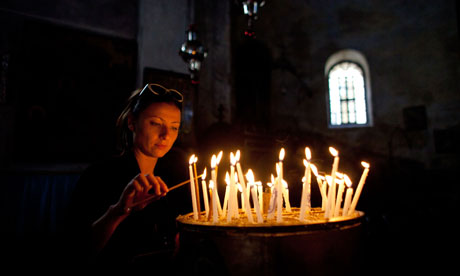
While in the Jewish world the personal touch of candles has been replaced by electricity, visiting the sanctuaries of other religious communities reminds us of how this commandment continues to be played out literally in some churches and temples, where devotees bring candles and light them in the sanctuary. This individual, humble and illuminating act speaks volumes of the individual responsibility to keep our communal institutions running.
Not as directly illuminating as the candles — nor as humble — the plaques at the entrance to our communal institutions also remind us that these institutions depend on our donations. But while the appearance of these plaques might lead us to believe that the responsibility to sustain our institutions lies primarily with the wealthy, the candles remind us that it is up to each of us to contribute to the effort. Indeed, in one synagogue in Jerusalem every lightbulb is donated by a different member of the community!
So how does the commandment to donate oil to the Temple play out today? An individual obligation towards overhead costs for those communal institutions we believe in seems like a good first step. But where else can we make a difference in supporting the work of the modern day priests (and Levites!) who toil in the sanctuaries of our communal institutions – Jewish, urban, civic… to make sure the lights are kept on
from sunset until daybreak…
Shabbat Shalom,

Mishael