Friday, September 4, 2015

Returning to our Senses #1: Eyes
Rabbi Mishael Zion | Text and the City | Elul 2015

Three organs are under a person’s control:
the mouth, the hands, and the feet.
Three are not under one’s control:
the eyes, the ears, and the nose.
Midrash Tanhuma, Toledot #12

This summer I studied with the 2015 Bronfman Fellows about various commandments relating to our senses and organs. Our focus was commandments of the Mouth: eating, gossiping, rebuking and praying. But the text that seemed to spark the most amount of thought and debate was the quote above from the Tanhuma. Are our organs under our control? Do we want them to be? Inspired by these questions, I’ve been using Elul, with its invitation for reflection and returning, to try to “come to my senses”. Focusing on how I control my sensory organs - and how they control me. Between now and Yom Kippur I hope to share texts and inspirations on those organs that are under our control (according to the Midrash), and those that aren’t. 
This first piece reflects on the eyes.

***
גַּל עֵינַי וְאַבִּיטָה (תהלים קיט:יח)
Uncover my eyes / So I can see (Psalms 119:18)

THIS has been a troubling week for our eyes. A human crises of global magnitude, brewing for years, crashed upon our eyes with one poignant, painful image. What the eyes have taken in cannot be erased. Cover my eyes, the online world begged. In our usual human weakness, it was not until the eyes SAW that we were shocked into realization, and empathy set in. Will action follow? "Uncover my eyes / so I can see."
Our eyes can be a wonderful moral actor, allowing us to go beyond ourselves and see the Other. And yet they are also our biggest adulterers. Our eyes are always somewhere other than where we are. Always hungry, on the prowl, never satiated. Beyond our control, says the Tanhuma and gives up. Yet a deeper look teaches that it is not simply about what we see, but what kind of gaze we embrace; what kind of eyes we develop.

Slit Eyed Looks

“Rabbi Yohanan ben Zakkai said to his students:
Go out and see – what is the key to the straight path a person should choose?
Rabbi Eliezer said: A good eye.” (Mishna Avot 2:9)

“We have sinned before you in narrow eyes
We have sinned before you in conspiratorial eyes,
We have sinned before you in proud eyes,
We have sinned before you in baseless hatred.” (From the Yom Kippur confessional)
עַל חֵטְא שֶׁחָטָאנוּ לְפָנֶיךָ בצרות עין... בשקור עין... בעיניים רמות... בשנאת חינם

IN the Guide for the Perplexed, Maimonides writes that 90% of all evil in the world is caused by man (the rest by the laws of nature, by the way, not by God, God forbid). The reason for human evil – is that Man experiences the worlds resources as a zero sum game. If you have something, it means there is less for me. The crucial resources are not just land, money, belongings, but eventually – love. Is there enough love for me too? That essential question of sibling rivalry, epitomized by what Cain felt that morning when God paid attention to Abel’s offering, and not to his. This town isn’t big enough for the both of us.

“Narrow eyes” refer to employing a zero sum game view of the world. “What you have – I want. The fact that you have it and I don’t makes it impossible for me to be happy for you”. I cannot look at the Other without immediately comparing to my own state. Narrow eyes engender conspiratorial eyes: “How can I get that for myself”. Both reflect an inability to see the Other on their own terms. The narrow glance – unwilling to be satiated with my own share – is the root of our betrayal of the Other, and of ourselves. Faith, says Rav Shneur Zalman of Liady, is about believing that “there is enough”, that the world is not a zero sum game. Turning from a materialistic world view to a spiritual one. What Rabbi Eliezer called: “Having a good eye”. Narrow eyes at their core are heretical – they claim that God does not have enough love in the world for everyone.

Eye to Eye, Face to Face
It is striking that the Yom Kippur confession focuses not on the actual transgressions against others, but on the distortions of our consciousness which led (or even just potentially might lead) to harming others. Rav Shagar (Shimon Gershon Rosenberg) connects narrow eyes to the next sin on the list: baseless hatred.
“The distortions of Narrow eyes and Conspiratorial Eyes are intertwined and cause the third and gravest sin: Baseless Hatred. Hasidism interpreted Baseless Hatred (Sinat Hinam) as hatred that emanates from the basic existence of the Other. The very fact that he exists irritates and burdens me. He burdens me because his very gaze causes me to lose my freedom, and from there a deep hatred rages forth, seeking to eliminate them.
This sin is the source of shame – we can no longer look eachother in the eye, face to face. Standing “face to face” represents a sphere in which we can treat eachother favorably, celebrate in the others existence. Kabbalah describes the mythical process of the High Holidays as generating a return of the divine faces back to being “face to face “, bringing back the simplicity, the warmth and the trust to relationships.” (“At the Door”, Rav Shagar Sermons for the High Holidays, 2001).

Breaking the Gaze

Within the writings of the great Teshuva movement called Gender studies, Laura Mulvey has taught us to see the male gaze employed all around us. Her call for Teshuva focused on the film industry, the way the camera lingers over the curves of a woman's body, putting the audience into the perspective of a heterosexual man. She’s allowed us to see how from “high” western art to street billboards to HBO, we’re constantly invited to internalize a sexualized gaze. In my dreams I envision a coming together of feminist theory about the male gaze and halakhic moralisms about keeping of the eyes (shmirat ha-eiynayim). In one respect this is the most patriarchal of Halakhot: don’t gaze at women says the Shulkhan Arukh (Even haEzer 21). Any flight between New York and Tel Aviv invites an encounter with an Ultra Orthodox man lowering his eyes when confronted with a women (then asked to be moved to a different seat on the plane…). The most jarring move of modern “modesty” discourse across religions has been the externalizing of the male gaze: instead of men being required to control their gaze, women are required to dress in a way that keeps the eyes of those men for them. The internal moral move of changing our gaze has become an external – and immoral - demand from others.
Can we get Shmirat haeiynayim to “do Teshuva”, returning to its source as a conjunction against applying the sexualized male gaze towards other people? One good place to start is with the Shulkhan Arukh’s commentator the Magen Avraham, who explains that the prohibition on looking at women is not about mere looking but about embracing a certain kind of gaze. Just as we are prohibited from “feeding our eyes” off the Priests when they offer Birkat Kohanim (the Priestly Benediction), he explains, so we must not “feed our eyes” off of people in a sexualized look. Helping our world wean itself off of the sexualized male gaze – and the fundamentalist response to it – could be a wonderful joint agenda of Feminists and Halakhists.

Eyes of Beauty, Eyes of Praise
So how should we look? Where does having a good eye start? Our technological age allows our eyes to see anything and everything in the world. We have seen it all before, on some google search somewhere. This spring I travelled to Arizona, encountering with my eyes some of the most beautiful views I had ever seen. Yet at first the redness of the rocks did not influence me – I had already seen it on my beautiful HD computer screen. The 2D HD image in my memory prevented me from truly seeing, from making room for a new, full gaze, of the beauty I had around me. My eyes were weary, cynical and unappreciative. It took several hours, days, until I could truly see what was right in front of me. And if it is so for radical beauty – how much more so for mundanity.

"I want to always have eyes to see / the beauty of the world and to praise” wrote Natan Zach, begging to "never become blind to the beauty of the world". As Rosh haShana celebrates the birth of the world, it’s a time to turn weary eyes into fresh eyes, to appreciate the beauty of creation, to embrace eyes that seek it out. Taking Rosh haShana as an eye-cleanse – from screens, from cynicism, for mundanity – to eyes that see so much beauty it makes us burst into praise. When our eyes dwell on beauty, forcing us to appreciate the inherent beauty found in the mundane – we can see the world, others and ourselves anew, and believe the world is not a zero sum game after all.

Thursday, May 21, 2015

Moonshine Shavuot: In Search of Obligation: Robert Cover and the Talmud

Rabbi Mishael Zion | Moonshine Sivan | Shavuot 2015

If you believe in mythical time, on this coming Saturday night the Torah will be given to you. Again. Shavuot doesn’t celebrate a historical event from the past, but rather a real occurrence that is about to take place. You don’t want to be caught off guard.
So we stay up all night and study Torah. Or at least we make a point, on this coming Saturday night, to study something. With a hevruta, teacher, child - or on our own. Mythical or not, we thus signify to ourselves that we are part of this thing called Torah, given to us anew each year.
This month’s Moonshine, dedicated to Shavuot and the month of Sivan, offers a Talmudic discussion and an article by a legal theorist, on the themes of Choice and Obligations, Rights and Commandments. Like all good learning, it’s psychology, political science, history and current events all rolled into one, if you take it there...
In case you haven’t yet made other arrangements, this might make a fine offering for Shavuot night learning.

***

What was given on Shavuot? What does “receiving Torah” mean?
In one reading, it is about mitzvah, being commanded. On Shavuot we celebrate being part of a path and destiny which is larger than ourselves. We bow our head to the authority on the mountain which has chosen us as their tool. We shall obey and we shall hear.
In another reading, though, on Shavuot we received Text. With Divine Text came Human Interpretation: questioning, understanding, misinterpretation, debate. Text invites our full autonomous self to engage, study, challenge – as a way of seeking (divine) truth. The authority of the text does not undermine my own authority, in fact it recognizes my autonomy, requires it, albeit challenging me to redeem myself from the vain and mundane. At its core lies a moment of personal choice.
These two readings play out – famously – in the Talmud (Shabbat 88), a text worth returning to each Sahvuot. The first opinion is that of Rav Avdimi. Mount Sinai hovering over my head, I have no choice. Accept the Torah – or die. Generations later, I might never have stood at Sinai, but that is the whole point: it isn’t about me. I am obligated.
Rava is having none of it though. “If that is the case,” says Rava, “then the binding nature of the Torah is like that of a contract signed under coercion – unenforcable.” Since God gave us text and law to study, we have developed based on it a self understaning of the importance of choice in the legal process. The Torah is a contract like any other – and must abide by the (human) rules set for it.
(There’s a third opinion, but that would take us to a whole other holiday. Study the full text here).
This classic discussion is played out in the essay “Obligation: A Jewish Jurisprudence of the Social Order” by the late and great Yale legal theorist Robert Cover. What is described about as an internal Talmudic debate, Cover takes as the basic difference between the “fundamental word” of the Western political tradition - “rights” - to that of Jewish law - “obligation”. Cover begins by playing out the two fundamental words of each tradition and the myths that fuel them:
Social movements in the United States organize around rights. When there is some urgently felt need to change the law or keep it in one way or another a “Rights” movement is started. The story behind the term “rights” is the story of social contract… making the collective arrangement the product of individual choice and thus secondary to the individual.
In Jewish law an entitlement without an obligation is a sad, almost pathetic thing… A child does not become emancipated or “free” when he or she reaches maturity, rather the child becomes bar or bat mitzvah – literally, one who is of the obligations” The basic word of Judaism is obligation or mitzvah. It is intrinsically bound up in the myth of Sinai, a myth of heteronomy. The experience at Sinai is not chosen.
When I first read this, I thought Cover was positing the power of Obligation as a traditionalist Jewish apologetic or as a conservative’s yearning for a lost past. Yet as he deepens the discussion, it becomes clear that he is expressing the yearning of the Liberal to obligate himself and his society in distributive justice:
A jurisprudence of rights naturally solves certain problems while stumbling over others. It has proved singularly weak in providing for the material guarantees of life and dignity flowing from the community to the individual. While we make talk of a right to medical care, the right to subsistence, the right to an education, we are constantly met by the realization that such rhetorical tropes are empty in a way that the right to freedom of expression or the right to due process are not… The “right to an education” is not even an intelligible principle unless we know to whom it is addressed. Taken alone it only speaks to a need. A distributional premise is missing which can only be supplied through a principle of “obligation”.
I believe that every child has a right to decent education and shelter, food and medical care; I believe that refugees from political oppression have a right to a haven in a free land… I do believe and affirm the social contract that grounds those rights. But more to the point I also believe that I am commanded – that we are obligated – to realize those rights.
Cover invites us to seek out this Shavuot how we can reclaim commandedness and obligation in service of the projects we believe in. The language of rights is powerful, but insufficient (as is the language of Obligation). It is an American question, and a Jewish one. No one likes being commanded, and yet we seek to be obligated to the things that matter most. Otherwise we'll never make it from the foot of the mountain to the promised land.

***
Dedicated to a theme in the Jewish month, Moonshine is a combination Dvar Torah and springboard for learning in the coming 30 days. Moonshine - in honor of the Hebrew month’s commitment to the lunar cycle, with a hint of distilling fine spirits off the beaten track and - perhaps - intoxication.

Thursday, April 16, 2015

Making it Count: Studying Sefirat Omer, Judaism’s Best Game

Rabbi Mishael Zion | Moonshine Iyar 2015 | Text and the City

“From the morrow of the Sabbath you’ll count fifty days,
And offer up a new offering to the Lord” (Leviticus 23)

Few things are sillier in Judaism than Sefirat haOmer, “counting the days” from Passover until Shavuot. This innocuous spring ritual consists of ritually reciting a number each night, then repeating the way that number divides into seven. Today is the Twelfth day, which is one week and five days to the Omer. Those who can count the correct number each night through forty nine, win a hefty portion of cheesecake on the fiftieth night. Undoubtedly, if it wasn’t for the brilliant game layerof Sefirat haOmer (forget one night, and you’re out…), this ritual would never have survived three thousand years of Jewish upheaval. Yet dig into the silliest rituals and you’ll find microcosms of the biggest questions.
This month’s Moonshine is an invitation to dig into Sefirat haOmer through three lenses: read the original verses in Leviticus, study Nehama Leibowitz’ exploration into the meaning of the original Omer ritual through traditional commentaries, or explore the Hasidic-psychological reinterpretation of the Omer in a delightful essay from the “Netivot Shalom” Rebbe of Slonim. You can even order a Sefirat haOmer spiritual workbook online. Sure, counting the Omer began a few weeks ago, but there are still five weeks left to make it count. Download one of these resources and study it before the fifty days are up.
A recap of some of these ideas and my own thoughts follows.
***
I love digging into the genealogy of Jewish rituals and uncovering their layers: the fossilized remains of ancient food, the lava-like polemics that have since frozen over, the small gems of interpretation that have crystallized amid the rocks. Studying the sources one finds that what at first seemed to be an empty shell of meaningless actions, held together by a sense of tradition, is actually a flourishing field. Feeding off the nutritious geological wonder hidden below it, it offers a fertile land for growth and rootedness today. Or something like that…
Such is the ritual of the counting of the Omer. At the bedrock level, it is an agricultural ritual of marking the grain harvest season, and counting from the very first crops to the peak of the harvest fifty days later, as described in Vayikra 23. It was a sanctification ritual of food and labor, recognizing the source of this goodness and zooming out to the larger purpose of our life’s work. In 16th century Tsfat, R. Moshe Alshikh described it as a corrective to affluence at the time of reaping profits:
“Affluence has the most pernicious effect on a person’s character, causing them to be haughty and arrogant… This can be avoided if a person acknowledges that Divine source of wealth instead of boasting that ‘my mighty hand has gotten me this wealth’ (Deut. 8:17). With the onset of the barley harvest, which is the earliest before beholding the abundant produce in the storehouses and on the field, man must recognize that his strength is illusory, for ‘all is vanity’ (Keheleth 3:19). Thus God has commanded us to offer up the earliest product of the harvest presenting the priest one omer as a token of gratitude… only after the omer has been offered up on the altar may Israeli enjoy the new produce of the year.”
But that agricultural reality ended hundreds and hundreds of years ago – covered over by a layer of Roman war and destruction. But the keen geological eye also recognizes the remnants of a great Jewish war, a huge intellectual debate between Pharisees and Sadducees, repeating a few centuries later between Karaites and Rabbinites. The focus: the start day of the Omer, and thus the date in which Shavuot is celebrated. Is it fifty days after Passover, or fifty days after the Shabbat after Passover? How does this frozen over lava of a debate resonate today? I hear in it echoes of the question of the Enlightenment: is liberation an end in itself, or only in the sense that it lead to a greater good? Is the Passover Exodus a sufficient redemption, or does it only bear meaning in its connection to the the covenant at Sinai on Shavuot? In other words, are Independence and liberty a goal in itself (negative freedom), or do they only set the stage for the achievement of a larger vision of society (positive freedom).
Rabbi Samson Rafael Hirsch in 19th century Germany claims that’s what the counting of the Omer is all about – creating a trajectory from liberation to construction, from exodus to obligation:
You have celebrated the Feast of your Liberation (Passover) and remembered before your God your independence, living in your land and eating its produce. You have therefore reached your freedom and the benefits of independence, the very goals all nations aspire to. You, however, are but on the threshold of your calling as a nation, and have started counting the days to the attainment of another goal. The Torah expresses the commandment of the Omer thus: “From the first time you put the sickle to reap the crops, you shall commence to count seven weeks” (Deut 16:9). When others cease to count, you being your counting.
Independence is amazing. It will be celebrated in Israel this week; will be reclaimed in every speech of an American presidential candidate in the coming 18 months; in the mouth of every graduating student this spring. But what is the goal of this independence? How does it tie into the achievement of a greater calling? It’s easy to agree about independence, but it’s what we do with it that matters. The counting begins now.
As one reaches the top of the Omer geological formation, a new layer appears. It is not about agricultural reality or national calling, but about personal journey. In the hands of Kabbalists and Hasidim, Counting the Omer becomes a psychological journey, an act of self-transformation, a tool of individual redemption. The grains of wheat turn into illuminations, the counting - a process of ethical and spiritual distillation. The Rebbe of Slonim articulates this best in his “Netivot Shalom”, then takes it in a surprising direction:
Counting (“sefartemספרתם) refers to the word sapir, meaning light, illumination. Thus “u’sefratem lachem” – ספרתם לכם – comes to mean “create for yourselves illuminations”. And these illuminations refer specifically to the elements of “on the morrow of the Sabbath”. The work of Sefirat haOmer should be specifically in the secular and concrete elements of life, those of the “morrow of the Sabbath”. Thus the seven weeks of the Omer are for finding elevation and holiness within that which is permitted, the bodily pleasures, the breadFor bread has two meanings in the Torah – actual bread, and sexual intercourse – food and sex. Distilling our relationship to these two elements is the new grain offering we are asked to offer at the end of the fifty days.
(A full translation of the Slonimer’sessay on Sefirat haOmer is attached here, in my humble translation. To explore the Omer as a journey of personal self transformation, I recommend Simon Jacobson’s delightful booklet: “A Spiritual Guide to the Counting of the Omer”)

Suddenly we are back in the world of actual grain, the Omer is about how we deal with “Bread”. Yet as the Slonimer notes, it is no longer about us as producers of grain, but as its consumers. This is where we need the work of refinement and distillation. Its not an easy process – and it requires disciplined daily work in order to be met.
Anthropologists have notes that good ritual is one which offers a very specific container yet leaves a lot of room for varied interpretation. Add onto it the game layer of the Omer, and you have the trappings of some excellent ritual. Life – at its base - is counting the time go by. Lets make that counting count.
Happy counting,

Mishael

Netivot Shalom on Sefirat haOmer | A New Grain Offering Translation

Sharing an abridged and "fast and loose" translation of my favorite modern Hassidic text...

“And you shall count for yourselves from the morrow of the Sabbath, from the day of bringing the Omer sheaf, seven whole weeks, until the morrow of the seventh Sabbath you shall count fifty days – and then bring a new offering of grain to the Lord: Two loaves of bread…” (Leviticus 23:15-17)
1
We must understand the significance of this “new offering of grain”; and why the Torah doesn’t give a specific date for Shavuot, only naming it the fiftieth day; and why we count forty nine days when it says to count fifty. And through these questions we can understand the deeper purpose of the Counting of the Omer.
For the entire period from Passover until Shavuot is one unit, in which the Exodus out of Egypt is completed. For the entire purpose of Passover is that it is “the time of our freedom”, in other words to exit into freedom from the enslavement to Pharaoh in Egypt – meaning the enslavement to the klipa, the external shell of Egypt. But this liberation is not completed until Shavuot, for “you do not have anyone as free as one who busies themselves with Torah”, and as it says “When you liberate the people out of Egypt – you shall come and worship me on this mountain” – meaning that the liberation from Egypt is only complete when you have worshipped Me at Sinai. For the Exodus and the Receiving of the Torah are one thing and stand on a continuum. For until a Jew goes through the period of cleansing and arrives so at the Receiving of the Torah – there is no complete “time of our freedom”.
2
Thus the period of Sefirat haOmer includes two aspects. The first is the completion of the Exodus, as it says in the “Divrei Moshe”:
 […] Just as the Exodus is mentioned in the Torah in regard to the commandments fifty times – so there are fifty aspects of leaving Egypt. And even after having left Egypt in one aspect – there are still many more aspects to be liberated from, up to fifty times. And in these fifty are included all the personal traits and attributes. For in each of them there is an aspect of Exodus. As the midrash states on the word “hamushim - armed did Israel leave Egypt”, to read “hamushim - only one in fifty left Egypt” that on the first day of Passover they were liberated from only one portion in fifty out of Egypt, and they were liberated in only one aspect of the 50 required for completion. And they had to go through another forty-nine days until they could leave out of all 50 aspects of the exodus.
Thus the goal of Sefirat haOmer is being a continuation of the “time of our freedom”: that in every day we have an exodus out of one more element of Egypt, until we reach the telos of the Exodus – which is the receiving of the Torah. And this is the point of the 49 days of the counting – to purify us from our shells and impurities – in other words to be liberated and redeemed from all fifty aspects of the impurity of Egypt.
Based on this we can understand why it says “you shall count fifty days”, for the number fifty includes also the first day of Passover, during which we are liberated from the first part of fifty of the Exodus, and then during the other days we leave the other 49 aspects. Now we can understand the need for the counting to be complete, such that if one missed one day of the counting – they can only count without saying the blessing. For every day of the Omer has an aspect of the Exodus, and if you missed one – you have not fully left Egypt.
Moreover, the counting must be continuous from the first day of Passover. Because all of the energy of the days of the counting come from the illumination of the first day of Passover. As the Rabbi Moshe of Koznitz says:
The first night of passover has an aspect of expansive mind (gadlut mohin) – for the light comes directly from the Creator unnaturally and suddenly – and then this expansiveness disappears and the person falls into smallness of mind (katnut) and a person must then collect the holy lights gradually one after the other in the days of the Counting (Sefirah), to elevate from one aspect (sefirah) to the next and to elevate themselves each time more and more until the holy day of Shavuot arrives, the day of the Receiving of our Torah, to arrive at that point to the essence of that first illumination from the first day of Passover – for that illumination gives power to the person to return to their initial strength. And all this is possible thanks to the light revealed on the first day of Passover, and even though that light disappears – there is still the trace of it (reshimu) from which one can get the power needed later in the days of Counting to strengthen and climb from one aspect to the next, each day a little more, until they arrive at Shavuot to that same initial illumination.
3
The second aspect to the Counting of the Omer is in its being a preparation for Shavuot and the receiving of the Torah. This aspect is rooted in what Rabbi Hayim Vital says: that the purification of one’s personal traits, the work of the midot, is in itself the creation of a chair and carrier in which to receive the Torah. For as long as a Jew does not purify their traits, they cannot receive the Torah, and the Torah cannot reside in them. Therefore as a preparation for receiving the Torah God gave us these days of Counting – during which the work is to purify our traits so that we will be worthy of receiving the Torah.
And they say in the holy books that the 49 days of Counting equal in gimatriya Lev Tov לב טוב – a good heart, which alludes to all the traits relating to interpersonal behavior, bein adam lehavero. As it says in Pirkei Avot: “Rabbi Yohhana ben Zakkai had five students and asked them: “Go and find what is the best trait a person can seek for themselves… and Rabbi Elzazar ben Arakh said: Lev Tov, a good heart; and R. Yohnan ben Zakai said: I see the words of Ben Arakh for his trait includes all of yours.” For the heart is the source and root of all personal traits.
And furthermore 49 in gimatriya is El Hai אל חי – Living God. As the AR”I, R. Isaac Luria, says is the name of the sefirah of Yesod, that when one purifies themselves in this sefirah they can feel the beating pulse of Divinity.
So the role of the days of the Sefirah is to purify and distill all the traits, both those relating to interpersonal behavior, seeking to achieve a Good Heart - Lev Tov, and those relating to one’s relationship to God – to achieve the experience of Living God, El Hai. For this is the true preparation needed in order to receive the Torah on Shavuot -  dependent on the work of distillation which takes place on the days of the Omer.
And as the Maharal of Prague wrote, that the true wholeness in a person requires three elements: Whole with the creator, whole with their companions, whole with themselves. And it is this type of wholeness which a person must strive for during this period, so that they will be worthy of the Torah residing within them. Thus the days of the Counting are a period of purification of our personal traits in order to receive the Torah. […]
4
And from this we can understand what the Torah means when it says “you shall count fifty days, and offer up and new grain offering to the Lord” (Lev. 23) – for this is the purpose of the days of Counting, that once a Jew has purified themselves and distilled their traits during seven whole weeks, then they will attain on Shavuot to “offer a new offering to God” in receiving the Torah. As it says in the Kli Yakar that the “new offering” refers to the Torah, as the Rabbis say “ every day the words of the Torah should appear to you as new” and each and every year these is a new receiving of the Torah. And this is why no exact date is given for Shavuot in the Torah – because the receiving of the Torah is dependent on the continuum which begins with the first day of Passover, and all the days from Passover, through the counting, until Shavuot – are all one continuous unit. And the more one invests in the work of purifying their traits and the work of interpersonal relations – so do they achieve a higher aspect of the Torah on Shavuot.
For the continuum works thus: The initial illumination which God shines on from high is an awakening from above (it’aruta d’leila) – for such is the “passing over” of Passover – and it all but disappears. Yet it leaves a trace throughout the 49 days which allows the Jewish person to slog and toil in refining their traits – creating an awakening from below (it’aruta d’letata). And it is based on this toil that the Jewish person creates the ingredients from which to offer a “new offering” on Shavuot, and arrive ready to receive the elevated illuminations of Shavuot and the Torah.
5
And my grandfather, in the Beit Avraham, says on the verse “and you shall count for yourselves from the morrow of the Sabbath” – counting (“sefartemספרתם) refers to the word sapir, illumination, in other words “sefratem lachem” - create for yourselves illuminations. And these illuminations refer specifically to the elements of “on the morrow of the Sabbath” – that the work of Sefirat haOmer should be specifically in the “secular” and concrete elements of life, those of the “morrow of the Sabbath”. […] For the seven days of Teshuva between Rosh haShana and Yom Kippur are for transgressing the forbidden, for correcting outright sins, but the seven weeks of the Omer are for finding elevation and holiness within that which is permitted, the bodily pleasures. […]
And thus we can explain why on Shavuot the offering in the temple was of two loaves of bread. For bread has two meanings in the Torah – actual bread, and sexual intercourse (as it says in relation to Joseph and Potiphar - “he allowed him all but the bread which he eats”). And this is the new grain offering we are asked to offer at the end of the fifty days.
This explains the contradiction regarding Hametz on Passover and Shavuot. For during Passover one must annihilate all hametz, implying that one must distance themselves from hametz in totality, and yet during Shavuot the Torah commands us to bring an offering of two loaves that are specifically made of hametz.
And we can explain this by relating to the two aspects which are called “bread”. That indeed before one purifies themselves in those two elements – food and sex, which are called bread – one must treat them like hametz, like something which is totally unnecessary. For while one is stuck in the 49 aspects of impurity, one cannot offer up an offering to God from among that which is impure. But once one has gone through the process of purification of the 49 days of counting, once they have purified themselves in those elements of “the morrow of the Sabbath”, then they can offer a new offering to God, even one that is from Hametz.


[1] Translation Rabbi Mishael Zion, fast and loose.

Thursday, April 2, 2015

“And Here the Child Asks”: Passover and the Pillars of Jewish Parenting

Tonight is the most important night of the Jewish year. It isn’t Yom Kippur, Holocaust memorial day or Hanukah. And it doesn’t take place in your Synagogue, or in Israel, or anywhere where you aren’t. It is Seder night, and it takes place in your dining room.
Seder night has a radical claim at its heart: that before Judaism is a religion, or a people, or a culture – it is a story; one that is told in a family context, in the first person. It is a story that is to be questioned, but also experienced, celebrated, dramatized and eaten. It is a story that is turned from narrative into nomos, from fable into values and practices – as we open the door for others. And it takes place at home, around your table.
If we were to choose a National Jewish Parenting Day, it would be Seder night (both of them!). Already in the Torah, before the Israelites even left Egypt, God and Moses fast forward to the quintessential moment of parenting: “And when your children asks you, 'What does this ceremony mean to you? (Exodus 12:26). This scenario is repeated three times, which – with the addition of one unasked question – will become the basis of the midrash about Four children at the Seder table. And it is upn this basis that the Rabbis turned Passover from a Temple based holiday – one which takes place there, away from home – to a home-made holiday, which always begins right here.
Passover Night puts into focus the two pillars of Jewish parenting: Calendar and Table. Nothing new here, it might be trite (“we’re all wise, we all know the story”), and yet I find it worth repeating: Calendar and Table are the two vehicles through which Jewish parenting takes place. And they both begin at the home, not with the outsourcing institutions of Jewish education we’ve become so dependent on.
Calendar. The Jewish story is first of all conveyed through the calendar, and that has remained its strongest suit to this day. Families who do not shape their lives around the daily observances and commandments of Halakha, nevertheless tie their family life to the Jewish calendar. Stories are thus woven into the temporal rhythm of the family, like birthdays that come around whether we like it or not. Awkward rituals containing memories demanding to be told, repeated. At its best, the very experience of time reminds us of the story, such that creation itself seems to be repeating the tale: the smells of spring herald the retelling of the Exodus; the darkness of winter beckons for the candles of Hanukkah; the falling leaves invites the reflectivity of Rosh haShana. As Heschel would put it, Judaism builds palaces in time, allowing the stories to reside not only in locations and institutions, but wherever we are. And as Yosef Haim Yerushalmi and Mircea Eliade taught us, what matters in the Jewish calendar is not history but memory. Did the stories “happen”? They exist not in the past, but in mythic time which repeats itself every year. In our modern technological life, as time has become an ever scarcer resource, the power of shaping time around our stories – even just a few times a year - cannot be underestimated, for our children and for ourselves.
Table. “As long as the temple existed – the altar would atone for Israel. Now – a person’s table atones for him.” (Talmud Brachot 55a). Faced with a dislocated Judaism, the Rabbis turned the family table into the central location of Jewish practice, and this continues to be the most powerful invention of Rabbinic Judaism. It was often trumped by the synagogue and the house of study/school, and has recently been sidelined by an era in which Jews sought to reclaim the public sphere and political space. And yet the family table must be the central altar, nothing really rivals it. Around the family table stories are told, conversations are had, and values are put into practice. Tables are always places of rules and mores - Parents try and teach their children how to “behave like human beings” and children challenge and undermine their parent’s authority – but can be so much more than that. Hospitality, that Abrahamic Jewish practice, challenges us to expand our table to people of all stripes and backgrounds.
Passover night is THE night of Jewish table, creating a constitutive moment that can then be translated into year round rituals, as we reconvene on a smaller scale around the table on Friday nights and other holidays. On Seder night, wrote Philo, even as the altar in Jerusalem still stood, “every home takes on the semblance of the Temple and receives its glory, the main course becomes the holy offering, and the participants are invited to purify themselves. Every other day of the year ritual is led by priests – on this night every family become the practitioners of the holy of holies.”
Four Questions, which are One: From Theory into Practice
All this sounds great in theory, and is most challenging in practice. Here are four questions raised in a recent conversation among parents in preparation for Passover. All four are different renditions of the question: Who am I doing this for?
The focus on children and parenting can often make the ritual feel empty and boring to parents. How do we avoid the infantilization of Jewish rituals to the point that grown ups – or teenage children – feel left out?
I’ve become more observant once I had children, creating a strong culture of Jewish calendar and table practices in the absence of much Jewish community around me. The desire to raise my children within the Jewish story becomes stronger the more I see it as a healthy antidote to a vapid consumer culture. Yet each year as I clean I wonder – if I’m mostly doing this for my children, why practice these rituals when they’re not watching? How much effort should I then spend on the pieces that don’t feel like they are particularly relevant - or noticeable – to children? Will they know that that I’m “only doing it for them”?
It’s all well and good to talk about storytelling at the Passover Seder, but the ritual itself allows very little room for it. Between the order of the Haggadah and the desires of the various guests and hosts, and the fact that everyone basically knows the story too, what exactly are we aiming for on this night? Getting the children to focus for a few minutes is hard enough, and rarely happens “in the right moment”, so how do I know that we’ve “performed the ritual as it should be” and be able to relax my grip the rest of the time?
I am not a parent, and have little interest in a night that is so child-oriented, when I am not one. What of all this relates to me?
Like on Seder night, these questions are deeper than any answers one can give. But a good sounding board for these questions can be found in Maimonides’ discussion of Seder Night:
One must make changes on this night, so that the children will see and will be motivated to ask: "Why is this night different from all other nights?" until he replies to them: "This and this occurred; this and this took place."
What changes should be made? He should give them roasted seeds and nuts; the table should be taken away before they eat; matzot should be snatched from each other and the like.
When a person does not have a son, his wife should ask him. If he does not have a wife, [he and a colleague] should ask each other: "Why is this night different?" This applies even if they are all wise. A person who is alone should ask himself: "Why is this night different?" (Maimonides Code, Hametz uMatza 7:3)
וצריך לעשות שינוי בלילה הזה--כדי שיראו הבנים וישאלו ויאמרו, מה נשתנה הלילה הזה מכל הלילות, עד שישיב להם ויאמר להם, כך וכך אירע וכך וכך היה.
וכיצד משנה--מחלק להם קליות ואגוזים, ועוקרים השולחן מלפניהם קודם שיאכלו, וחוטפין מצה זה מיד זה, וכיוצא בדברים האלו.  אין לו בן, אשתו שואלתו; אין לו אישה--שואלין זה את זה מה נשתנה הלילה הזה, ואפילו היו כולן חכמים.  היה לבדו, שואל לעצמו מה נשתנה הלילה הזה.
Maimonides’, based on the Talmud, grounds Passover night in a series of games, surprises and changes – which are all aimed at eliciting spontaneous, real questions from the audience. “Snatching matza” is the afikoman game, “seeds and nuts” are the desserts of old. Give out candy, do strange things – anything to keep this night alive, fun and relevant.
But a moment before Passover night turns into a child-oriented circus, Maimonides pauses to ask: what if the classic imagined audience is not there? What remains of Passover without parenting? A person who is alone should ask himself: Why is this night different?”
I find the image of a person, sitting along and asking themselves questions on Passover night, to be the most poignant image of ideal parenting. Anything we do with our children, ideally, would be something we would do on our own, for ourselves, if we could. And when we do it with our children, the engine for it should not just be in them – our desires, fears, or hopes for them – but in something in ourselves. This is not about being self-serving, but about integrity, acting from a place of existential grounding, from our best selves. Children sniff it out immediately if it does not emanate from such a place.
Granted, we are rarely our best selves when we are alone in a room. So much of early parenting is trying to regain best practices which we allowed slide during adulthood (clean language, no snacking between meals, limiting screen time, making time for what really matters). In fact, it is far easier to do things for our children and to expect of them the highest behavior – while struggling to reach those bars ourselves. In response Maimonides’ offers an image of parenting as a series of concentric circles – ideally we should be having the same conversations with our children as we have with our spouse, our friends, ourselves. Parenting allows us to put on a mask of our best self, or a mask of an ideal world which we want to give our children – but we must make sure that the mask is never too distant from who we are by ourselves, with our friends and with our spouses. And the relationship should work both ways: the stories we tell our children, the questions they ask of us, must shape who we are as adults as well. In that sense, talking about parenting is just a way of talking about who we want to truly be. Turning that into practice, well for that we need a whole bag of tricks up our sleeve – for our children as for ourselves.
Hag Sameach,
Mishael


Thursday, March 12, 2015

An Amateurs’ Guide to the 2015 Israeli Elections

I don’t usually write about politics, but thought I’d share some thoughts on the upcoming Israeli elections. Hope this is helpful in making sense of what’s going on and looking forward to learning from other voices that see things differently than I…
Mish

An Amateurs’ Guide to the 2015 Israeli Elections | Mishael Zion

Israel is going to the polls on March 17th, for the third time in six years. The campaign began with most Israelis fatigued and cynical, but schisms and unions among Israel’s political parties have energized these elections and offer a poignant glimpse into the changes that Israeli society is experiencing. Much attention is given to Netanyahu’s prospects of becoming prime-minister of Israel for the fourth time, and the enormous energy spent to replace him (check out the videos on this FB page). But the real drama unfolding in Israel’s streets, cafes and living rooms is the dilemma of the undecided. Recent polls have shown that upwards of 20% of the population say they have not yet decided how to cast their vote. Likud and Labor are currently polling neck-and-neck, so it is the number of seats which the small parties will receive that will determine whether Labor’s Isaac Herzog can create a coalition of 60+ Knesset seats, or if Netanyahu will receive the reigns yet again.
Since I know many Americans have a hard time keeping track of Israel’s gazillion-party-system (which is almost as broken as the two-party-system), and in an attempt to justify the many hours I’ve spent reading analysis and watching videos on my facebook feed, I offer four fictional, stereotypical and totally biased narratives highlighting some of the questions Israeli voters are asking themselves. You’ll notice that Iran and the Palestinians, US-Israel relations and ISIS are not the focus here – that already is saying something. At the end of each narrative I’ve provided some of the recent poll numbers. Videos from each party’s campaign with English subtitles can be found here (and here's John Oliver's hilarious recap). Hope this is helpful as the elections unfold in the coming week and look forward to questions and alternate readings…

The Centre-Right: Will the real Begin please stand up?
Aryeh Deri and Moshe Kahlon
I’m your Jerusalem cab driver, Mickey. What’s that? Yes, I was born in Algeria, and I’ll never forget how my father’s honor was denigrated by those anti-religious euro-centric Ben Gurion-ists. The first politician who got my loyalty was Menachem Begin, who spoke to us at eye level, and it’s been Likud straight through ever since. But recently Netanyahu has lost me. All this talk of Iran – well, sure, its important, and he’s the ONLY ONE who is strong against a hostile world – but we’re struggling down here. Bibi talks about a “Start Up Nation” – but we haven’t seen a cent of that. This time I’m thinking of voting for Moshe Kahlon. He’s all that’s left from the Real Likud, the Begin way. He’s a good guy, and his cell phone reform saves us 200 shekel a month. Let him be Minister of the Treasury and lets see if he can do that to 3-4 other industries, that’ll be worth my vote. My wife says we should vote for Shas. Aryeh Deri is back now, and he’s been banging the drums of anti-Mizrachi discrimination – saying he’s the only one who ever did anything for the “transparent” ones in society, emphasizing the “Mahlouf” in his name. Funny, that was my name growing up too, but everyone calls me Mickey. But now they say Kahlon and Shas might join a Labor coalition, maybe it’ll be Bibi after all…
Likud | Binyamin(“Bibi”) Netanyahu, polling at 20-25 seats | Bibi as the National Babysitter
Kulanu | Moshe Kahlon | 7-10 seats | Claiming Begin’s true path
Shas | Aryeh Mahlouf Deri | 7-10 seats | Transparency – Mizrachi Israelis

The Liberal Left: Zionist after all or united with the Arab List?

I guess I’m your classic secular Tel Aviv stereotype, a literary editor at a publishing house, still stinkin’ smolani”, with a long, hissing S, my whole life, but the verbal violence turned physical in the streets of Tel Aviv this summer. It sometimes feels like all my friends have moved to Berlin or Berkeley, and lecture me on how Zionism is passé. Still, the social protests of 2011 brought back some of my faith in this society, and the Meretz Knesset members make me proud with their struggles for women’s rights, LGBT rights, a welfare state. I’ve voted Meretz ever since Rabin was assassinated – still remember crying for him in the square for days – but last elections I voted Hadash, the veteran Arab-Jewish communist party. It was a statement of the inability of the State of Israel to be both Jewish and Democratic – and I know what side of the equation I’m on. But now the Arab parties have all united, and a vote for the exciting new Hadash leaders is also a vote for the ultra-nationalist Palestinian parties and the religious Muslim Movement. If Labor wins, my Meretz vote might find itself supporting a watered-down coalition with haters from the right. But can I vote for transcending the Jewish-Arab divide when half the candidates draw that line from the Arab side?
working on my first novel, and proudly in Israel’s far left wing. I’ve watched this country take a swerve to the right, becoming more “Jewish” then I ever remember it, increasingly dominated by an ethno-centric discourse which casually hates Arabs and recently began to proudly hate Leftists. I’ve been called “
Meretz | Zehava Galon | 4-6 seats | Meretz against voting Labor
United Arab List | Aiman Ouda | 12-15 seats | United Arab List Theme Song

The Religious Right: Jewish Home or All-Together-Now
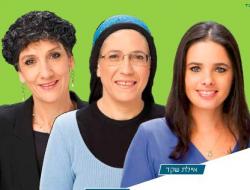
HaBayit haYehudi: Female leadership
Adi and Yishai Schwartz live in Ranana, met in Bnei Akiva, have 4 kids, and like everyone else they know - are voting for Naftali Bennet’s modern-orthodox “Jewish Home”. Bennet announced that he is no longer apologizing: not apologizing to the world for the so-called Occupation, not apologizing to the Palestinians for their so-called suffering (it’s isn’t suffering when its self-inflicted). But truly he stopped apologizing to the secular Israelis for the fact that religious Jews were late comers to the Zionist endeavor. It is time religious Jews teach something about Zionism to secular Israelis. Even Yishai’s secular partner at the law firm is voting Jewish Home this time. But the Schwartz’s are distraught – their youngest son Nerya came back from Yeshiva and announced that he is voting for the new schismatic party “Yachad”, formed by renegade Ultra-Orthodox “Shas” Mizrachim, far-right religious Zionists and Kahanists. Nerya criticizes Bennet (and by proxy, his parents) of not truly
Ultra Orthodox, Mizrachim and Dati'im: Yachad
listening to Rabbinical authority, of being “light”, aspiring to be like Westernized secular Israelis instead of more like the Torah-true Ultra Orthodox Jews. Ever since his fiancé’s family was evicted from Gush Katif, his faith in the State of Israel being a vehicle of God’s will has imploded. The exuberance felt at the “Yachad” party gatherings is huge – finally ultra orthodox Jews can say they are right-wing and admire Israel’s strength, and right-wing religious Jews can say they admire Haredim. They believe in love (of Jews), unity (with Jews) and solidarity (with Jews, especially religious ones). Who can argue with that?
HaBayit HaYehudi | Naftali Bennet | 10-15 seats | Bennet’s Aplogizing Hipster
Yahad | Eli Yishai | 4-6 seats | Rabbis United

The Centre Left: The Ashkenazim who lost the Country
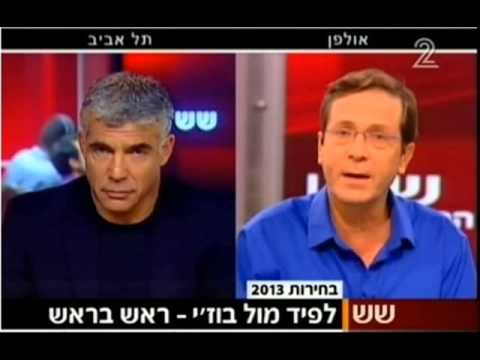
Yair Lapid and Isaac Buzi Herzog
Eli and Sarit Katz are sick and tired of a political discourse that overlooks their daily needs. Iran shmiran, they have been married 15 years and are still renting in Herzliya, having watched apartment prices soar over the past 8 years. They work hard - he’s in sales, she’s an accounts manager. They own 1.5 cars, have 2.5 children and 0.5 pets. Did I mention that they are Ashkenazi? In the 90’s they voted for Yitzhak Rabin and Ehud Barak, and wanted to believe in peace with the Palestinians, but the second Intifada and the wars with the Hamas in Gaza have made them cynical of talk of “peace”. They believe in a “normal Israel”, one located in Western Europe, not the Middle East, and would happily get rid of the West Bank – its Jewish or Palestinian residents – as long as someone can promise them that flights from Ben Gurion airport will continue unabated. They want to feel there is a future for them and their kids here, one where they can afford to buy a house and make a normal living - so last elections voted for Yair Lapid - whose good looks first charmed them as Israel’s prime-time talk show host. Yair talked about middle class and promised to force Ultra-orthodox Jews to serve in the army and join the workforce. He made good on the promise (sort of), but achieved little else. Now this Herzog kid is gaining steam, and suddenly seems like he can actually push Netanyahu off his seat. Sure, he’s unimpressive at first, but he’s growing on them. It’d be nice to vote for Labor again, and the cadre of politicians in Labor’s list is more impressive than Lapid’s minions. Huh, we’ll have to wait for the last day to really make a call…
Labor / Zionist Camp | Isaac (“Buzi”) Herzog and Tzipi Livni | 20-25 seats | Last minute to save the country
Yesh Atid | Yair Lapid | 10-15 seats | Yair Lapid on tour

This is far from the whole picture (see below), but I hope it’s somewhat helpful.
What’s next? The prime ministership is assigned to the party which can assemble a majority coalition of 61 seats (out of the Knesset’s 120). It is generally assumed the Kahlon, Lapid and Shas will join any coalition, but more parties would prefer a Netanyahu led government. Thus while Labor might receive the largest amount of seats, it might not be able to cobble together the majority needed to make Herzog prime minister. Netanyahu’s Likud has more options, but if it dips below 20 seats, will have a hard time justifying it. Everyone knows there will be a few big surprises when the final results come in Tuesday night. What they will be, and how they will shape Israel’s future – are anyone’s guess.

p.s. Missing from the picture are the Asheknazi Ultra Orthodox (UTJ) party polling at 6-8 seats, and Avigdor Liberman’s party, hit hard by corruption charges but keeping its base of Russian voters at 4-6 seats. Lieberman, Meretz and Yachad are all teetering on the 4-seat-minimum for entrance into the Knesset at all. If any of those don’t pass muster, the coalition picture will change significantly. Finally, was below the 4-seat-minimum, but most fascinating of all, is a party of Ultra Orthodox women who refuse to vote for the Ultra Orthodox parties because they do not give representation to women. A harbinger of the way feminism is changing Israeli society on a daily basies.