Thursday, January 10, 2013

Moses’ Sword: Jewish Magic and the Importance of Culture Wars


Rabbi Mishael Zion | Bronfman Fellowships | Text and the City | VaEra 2013


“If at a full moon you wish to seize and to bind a man and a woman so that they will be with each other, and to annul spirits and blast demons and satans, and to bind a boat, and to free a man from prison, and for everything – write on a red plate from תובר תסבר  until הע בשמהט.
And if you wish to destroy high mountains and to pass  through the sea and the land, and to go down into fire and come up, and to remove kings, and to cause an optical illusion, and to stop up a mouth, and to converse with the dead, and to kill the living, and to bring down and raise up and command angels to abide by you, and to learn all the secrets of the world – write on a silver plate, and put in it a root of artemisia, from תובר תסבר  until הע בשמהט..
Excerpt from Harba de’Moshe, The Sword of Moses, a Jewish magical treatise from 7-9 century

This week’s parasha, VaEra, portrays the “Magicians showdown” between Moshe and Pharaoh’s Sorcerers. It is part of God’s cultural war against Pharaoh’s political-theological system, so that “the Egyptians shall know that I am the LORD, when I stretch forth My hand upon Egypt, and bring out the children of Israel from among them” (Shemot 7:5). Biblical commentators saw this as a kulturkampf – the cultural war between “real religion” over superstition, of miracles over trickery, of monotheism over idolatry. Magic was synonymous with a culture of enslavement, inauthentic power, charlatanism and idolatry.
But for some readers, like the author of “Moshe’s Sword”, the magical user’s guide quoted above, the Magician’s showdown is the founding moment of Jewish Magic – a rich tradition which saw Moses as the ultimate sorcerer. This short, quirky book encourages Jewish Magicians to follow in Moshe’s footsteps so that they too can wield the powerful verbal weapon which is “Moshe’s Sword”. The book, which was recently published in an updated English translation by Yuval Harari is a fascinating case study for the cultural wars within Judaism to this day. [For more links to the book and a longer post on the “Sword” see the Text and the City website]
The Jewish magical tradition, while esoteric and often polemical, was extremely popular throughout Jewish history – until Protestantism came along. In a Kulturkampf reminiscent of Moses and the Egyptian sorcerers, magic was exorcised from Judaism in 19th century Western Europe as part of Judaism becoming a Protestant religion (see Bronfman alum Michah Gottleib’s “Are we All Protestants Now?”). If Orthodox and Reform Jews in Germany and America could agree on one thing, it was that Jewish magic (and mysticism) was a contamination of the “pure religion”, an irrational hunchback which grew on the body of the otherwise rational and mature religion known as Judaism. Nothing else would be befitting the Mothership of Monotheism which gave birth to Christianity.
To this day many “Western Jews” are surprised by the prevalence of mysticism, magic and other “superstitions” within mainstream Judaism. Tellingly, in Eastern European (Catholic) and Arab (Mulsim) countries the Protestant “othering” of magic never happened – mystical/magical/superstitious rituals are commonplace to this day. In America it was through Yiddish literature that this tradition was allowed to live on (think of the Dybbuk, the Golem or Bashevis Singer’s demons); relegated to folklore and popular (i.e. low) culture, magic had no hold on the rational adult religion which is Judaism.
To be sure, belief in magic – aside from probably being wrong – has many morally disturbing aspects, fascinating in their own right. Maimonides objected to magic and astrology’s determinism which undermine moral responsibility. As the incantations quoted above show, magic often involves a use of divine power for self-interested and petty reasons, which are a desecration of the holy (in a way as disturbing as the way people “desecrate” politics or religion with their petty self-centered goals). Finally, there is an inherent violence engrained in magic: it is about coercing divine powers to do the Magician’s will, an aggression towards Divinity which implicitly justifies violence in other means.
Despite all these, I believe telling the story of Jewish Magic is fueled with an ideological urgency not unsimilar to the kulturkampf of old. Feminism and critical race theory have taught us the importance of giving voice to marginalized ideas which were sidelined by hegemonic powers over the ages.
Moses the Magician: Dumbeldore or Gandalf?
With the Age of Reason in twilight, the Protestant assumptions about religion and rationality do not hold sway as they used to. Rationality is being re-examined not only in religion but in economics and psychology as well (see Daniel Kahneman). Religious affiliation is declining (in the affluent North) and being redefined (as fundamentalism?) the world over. Judaism is struggling to grow out of the confines of being a (Protestant-style) religion.
If in the last 200 years Jews have been asking whether Judaism is a religion, a culture or a nation, it is time to admit that we are none of those things, and all of them. We are not really an “ism” at all (as portrayed in a recent “Bizzare Judaism” showcase organized by an Israeli Bronfman alum and funded by our alumni Venture Fund).
What is the alternative? Some see a pluralism of Jewish stories which is no more than a mish-mash Jewish quilt where all Jewish phenomena are “celebrated” equally. Personally, I’d rather see a world in which Jews in various situations fashion the Jewish building blocks at their disposal into Moses’ Swords of a wide variety, shaping Jewish visions and ways of life that further the issues they care about, with each then “making battle” a healthy conflict of ideas. As Yeshayahu Leibowitz once said: “The very thing fools fear is what we desperately need, what in European political jargon is called Kulturkampf.  The struggle is essential for intellectual and moral health.” “Moses’ sword” is a powerful reminder of how this idea has played out in surprising – and powerful – ways for centuries.

Moses’ Sword: On Rabbis, Sorcerers and Verbal Weapons


Hidden among the shreds saved from the Cairo Geniza, and deep within a tome of ancient magical Jewish manuscripts, is a book known as “The Sword of Moses” [חרבא דמשה]. One part disclaimers, two parts magical recipes, and a whole lot of gibberish in the middle, it is a fascinating and loopy users guide for becoming a Jewish magician of the most powerful type. We know very little about the books author (is was probably written in the Land of Israel during the last quarter of the first millennia) but the book has been recently re-published in an academic Hebrew version and in an English translation thanks to the work of Dr. Yuval Harari. Reading this short book – which I recommend for people regardless of their skill at sorcery – brings up fascinating issues about violence, self interest and the limits of human power (in a separate blog post I reflect on the place of magic in contemporary Jewish discourse). [Online you can find an un-annotated Hebrew version and an old english translation which censors most of the fun parts]
As Harari writes: “The Sword of Moses is the largest and undoubtedly one of the most important of all surviving texts from early Jewish magic literature. It comprises three main parts: (a) the ritual for gaining authority over the sword4; (b) the sword; and (c) the practical section.”
The beginning of the book instructs the reader that in order to attain control of the sword, three days of fasting and self-purification must be taken on. The fasts are interlaced with rituals of commanding the thirteen archangels that are “in charge of the sword which is delivered from the mouth of eje ef ej ef ea the Lord of Mysteries, who is also in charge of the Torah.”
The sword itself is a verbal weapon, comprising of 1,800 names of angelic creatures, which read like long strings of meaningless syllables. Wielding the sword promises the magician control over all these angels and all their powers.
How does this magical control of divine forces work theologically? For this the author of Harba de’Moshe has an elegant, monotheistic, solution: God – according to Harba de’Moshe – has given Moses the power over all the angels, through the word. Moreover, he has decreed that any subsequent person who wields the sword will have the same powers as Moses did:
“Do not impede any mortal who will appeal to you and do not treat him otherwise than my servant Moses, son of Amram, for he appeals you by My Ineffable Names and it is to My Names that you render honor and not to him. But if you impede him I will burn you for you have not honored Me.”
A series of words which, if mastered, gives the user the power of Moses himself? This sounds like familiar Rabbinic ideas on speed. The Rabbis radically placed words at the center of the universe: the world was created by words, it is redeemed through words (of Torah) and can be destroyed through words (lashon ha-ra). Whoever masters the words of Torah, like Rabbi Akiva, has the power to almost redefine the meaning of the Torah, empowered by God himself (as in the story of Moses in Rabbi Akiva’s beit midrash). In the hands of the magicians, however, holy words are not just the building blocks of the universe, but can also be inflicted back on divinity to force them to do your will.
This is where magic, for all its quirky coolness, also become ethically questionable. If for the Rabbis the Torah is a weapon for creating a just society or implementing God’s vision for the world, for the magician this holy weapon becomes a way of achieving goals that are both self-interested and petty. Here are a few examples:
If at a full moon47 you wish48 to seize and to bind a man and a woman so that they will be with each other, and to annul spirits and blast-demons and satans, and to bind a boat, and to free a man from prison, and for every thing,write on a red plate from TWBR TSBR until H’ BSˇMHT.49 [2]And if you wish to destroy high ountains50 and to pass (in safety) through the sea and the land, and to go down into fire and come up,51 and to remove kings, and to cause an optical illusion, and to stop up a mouth, and to converse with the dead, and to kill the living, and to bring down and raise up and adjure angels to abide by you, and to learn all the secrets of the world, write on a silver plate, and put in it a root of artemisia, from TWBR TSBR until H’BSˇMHT. [3]For a spirit that moves in the body, write on magzab52 from TWBR until MNGYNWN. [4]For a spirit that causes inflammation, write from MGNYNWN until HYDRST. ’. [5]For a spirit in the whole body, write from HYDRST. ’ until H’ BSˇMHT. [6]For a demon, write from H’BSˇMHT until Y’WYHW.

There is another troubling aspect to the magic at hand: it is achieved through violence. The Sword of Moses is a way of forcing divine powers to do your will. The coercive premise at the core of magic was one of the things that troubled Jewish philosophers throughout the generations, not only because of the way it seems to undermine monotheistic perfection, but because of the violence and coercion at its base, which show a deep disrespect and desecration of the Holy. It is interesting to compare these two critiques
Names/incantations from Harba DeMoshe
Using these critiques of magic, it would be interesting to return to our own figures of authority and ask: what is today’s charlatanistic authority; who today uses power for petty and self-interested motives instead of furthering a vision of good; and whose authority today is rooted in a basic violence which, while possibly invisible, is quite troubling…
Despite these criticisms of magic, reading Harba d’Moshe is a fascinating exercise in the diversity of Jewish experiences, and how wide the net of Jewish texts, ideas and culture can be spread. It is also a fresh midrashic light on Moses’ character – the all powerful sorcerer. One must go beyond the confines of Harba d’Moshe  in order to encounter the boundary of what magic can do for you. A midrash describes how at the end of his life, Moses – for all his amazing powers – is over-powered by God’s decree: he will not enter the land. The midrash, which is clearly aware of the idea of Moses’ power being “magical” while also hesitant about how overtly to point  this out (incantation is framed here as prayer…) describes how Moshe uses all his powers to fight this decree. His ability to coerce the heavens is feared in the higher registers of power, and God has to protect himself from hearing Moses’ plea:
When Moses saw that the decree against him had been sealed, he resolved to fast, and drew a small circle and stood therein, and exclaimed: “I will not move from here until you annul that decree.” […] He donned sackcloth and rolled in the dust and began to pray before the Holy Blessed One ...
God hastily summoned angels and commanded them: “Descend quickly! Bolt all the gates of every heaven! For the voice of Moses’ prayer threatens to force its way into heaven!” The angels sought to flee to heaven because of the sound of Moses prayer, for this prayer was like a sword which tears without any delay, for his prayer was of the nature of the Ineffable Name which he had learnt from Zagzagael the Master Scribe of the children of heaven.
Midrash Deuteronomy Rabbah 11:10

Moses has been armed like no human before him: he has the power to tear through the heavens with his powerful “sword”. Yet even the all-powerful Moses meets his limitation: mortality. Moses’ tragic end is a reminder that even in the highest echelons of power, limits exist. In this midrash, which might a polemic of sorts with the “Sword of Moses”, wielding the sword of Moses does not save one from the confines of mortal life – the opposite, it only strengthens the gravity of human action.

Monday, December 31, 2012

2013 New Year’s Resolution: Go Out… and See


Rabbi Mishael Zion | Bronfman Fellowships | Text and the City | Shemot 2013


I am not a big believer in New Year’s Resolutions, whether they come in Tishrei or in January. They feel like a tokenistic, gratuitous act, to be flicked off like a dry scab a few weeks into the New Year. Yet sometimes it is the smallest shift of focus which can open the door to enormous change. Inspired by the first Parasha of the new year, Shemot, I aspire this year to give a new twist to the most mundane of acts: seeing.
A strange midrash describes our ancestor Primordial Adam as having the ability to see “from one end of the world to the other”. This might be classic rabbinic hyperbole, but compared with, say – 1813 - we in our generation have again reached the ability to “see from one end of the world to the other” - from the comfort of our mobile device. This information revolution has raised awareness to many ills, and spawned revolutions where before ignorance and oppression reigned. At the same time, it has created a “compassion fatigue” where headlines come and go and we become increasingly cynical and unsympathetic. Faced with the ability to hear endless points of view on any issue we are increasingly putting on the horse blinders of parochial media outlets, creating homogeneous virtual villages of our own ideasas our fatigued eyes close to all things that don’t already fit our view.
With the ability to see everything, a new “ethic of seeing” is required, for what and how we see is the key to all moral behavior. 
The opening of the book of Exodus makes a similar point. In the portion which will be read by Jewish communities the world over on the first Shabbat of 2013, Parashat Shemot describes how the distorted sight of Pharoah turns the Children of Israel in Egypt from upright citizens to dangerous others; then to invisible slaves; to the objects of genocide; and finally to candidates for annihilation.
“The Mother of Moses,” Simeon Solomon  1860
Or so it would have happened if not for the moral courage of a handful of women, who are described again and again as simply – seeing. The term “to see” appears 22 times in the first three chapters of Exodus, essentially every third verse. When Pharaoh orders two midwives to kill any Israelite baby boy they see, they instead “see God” and refuse to kill. In a description evocative of God’s seeing in Genesis Chapter 1, a young mother “sees that her child is good” and places him in an ark. Consequently, Pharaoh’s daughter “saw the little ark among the reeds… opened it and saw him, the child!” It is this seeing which is immortalized in Moses’ name: “She named him Moshe, He-Who-Pulls-Out; saying: “For out of the water I-pulled-him (meshitihu).” Ethical seeing is the pre-requisite to any act of moral salvation.
True to both his biological and adopted mothers, Moses is a person dedicated to ethical seeing. Upon entering adulthood, Moses has the entire world open to him. Yet his first act is described as follows: “He went out to his brothers – to see in their burdens.” Rashi points out that this is not a simple act of sightseeing, rather:
“He directed his eyes and his heart to share their distress.”
וירא בסבלתם: נתן עיניו ולבו להיות מיצר עליהם:
Rashi astutely points out that the heart follows the eyes. To truly “see” is an act of the heart, not just the eyes; it is an act of deep compassion. What are the ethics of sight according to Exodus Chapter 1-3? Inspired by young Moses, one must “see in their burdens” – to see with heart as well as with eyes, in a directed manner, fighting off compasion fatigue. Moreover, it is about “going out” – going beyond our regular circles of information to gain new (in)sight.

How does this translate into action for 2013? For our information addled generation, we must be purposeful about where we direct our sight. Since the primary way we “see” today is by consuming written and visual media, we must curate out information guided by moral vision. We must “go out” of our usual information silos, reading opinions and reports we disagree with, consuming media in a purposeful way and from a myriad of perspectives, overcoming our compassion fatigue. In the last confrontation between Israel and the Hamas, I attempted to consume media with purpose: reading and watching an increased amount of TV from “my brothers” in Israel, but also “going out” and reading about the plight of Palestinians and seeking out the perspective of Al Jazeera. I read the analysts who preached to my comfort zone (Haaretz?), as well as the pundits whom I vehemently disagree with (Arutz Sheva? When I disagree with them they are always pundits…). “Going out” does not mean not taking sides – I know who “my brothers” are – yet I feel there is an ethical imperative to constantly widen my lens of sight, in all directions.
Beyond virtual consumption of media, “going out and seeing” is to be done in person and in our local communities. I salute those who simply drove out to Newtown, the Rockaways or Beer Sheva, to see first-hand and “share their distress”, not to mention lending a hand. Yet seeing ethically also begins right in our backyard, seeking out those who are invisible to us. There are few experiences more degrading than feeling that one is not seen. Like Pharaoh’s daughter, we must seek those hidden by the reeds whom we have trained our eyes not to see, and refresh our seeing of them. We must “go out… and see”.
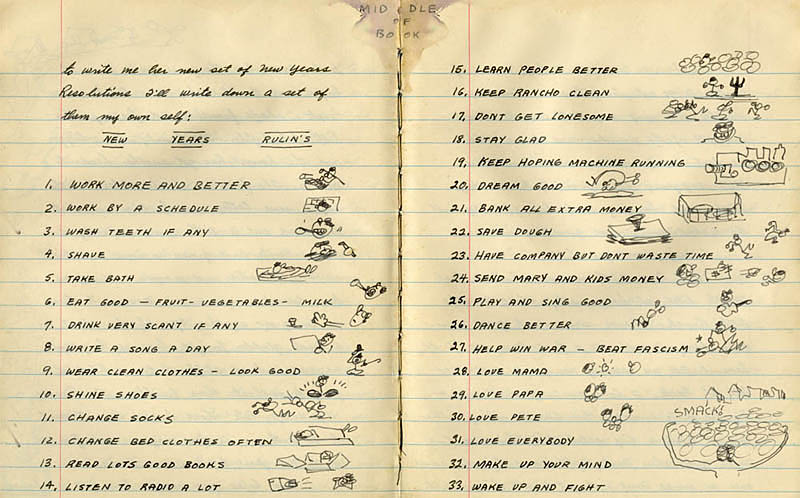
Woody Guthrie's New Year's resolution, 1943
We might not be able to right all the wrongs of the world in 2013, but seeing them is the first and crucial step towards a better year for all. I hope to still be seeing in this new light in February, continuing to explore and refine what "ethical seeing" means in the 21st century. If you see me around, please nudge me to keep it up.
Happy 2013,
Mishael


Tuesday, December 18, 2012

Becoming a Community of Comforters: Newtown’s Charge to America


“There is no revenge for the blood of a little child – such a revenge has yet to be devised by Satan,” wrote Hayyim Nahman Bialik about a very different massacre over a century ago. In lieu of vengeance, Bialik calls for a cosmic response: “Let the blood pierce through the abyss!”
As the children and teachers of Newtown are being taken to their final rest this week, one can feel the blood piercing through that abyss – the abyss of human cruelty, the abyss of our inability to fully protect our children, the abyss of society’s obligation to its weakest links.
Many of the darkest challenges of American society have been exposed through this massacre, but one often overlooked challenge is American culture’s relationship with death and offering comfort. Newtown might present a moment of change for this culture.
You are not alone in your grief Newtown. Our world, too, has been torn apart. All across this land of ours, we have wept with you. We’ve pulled our children tight. And you must know that whatever measure of comfort we can provide, we will provide. Whatever portion of sadness that we can share with you to ease this heavy load, we will gladly bear it. (full text here)
The “Comforter in Chief” has enlisted us in the work of consolation. As we as a nation struggle to answer this call, we would be wise to take some cures from Jewish sources, renowned for their unique approach to mourning and loss, and the emphasis given to its importance. Indeed the Talmud describes the work of comforting as the most sacred of acts:
Rabbi Hama son of Rabbi Hanina taught:
What is meant by the passage, "You shall walk after the Lord, your God" (Deut. 13:5)?
Is it possible for a human being to 'walk after' the Divine Presence, about which it is written: "The Lord, your God, is a consuming fire" (Deut.4:24)?
Rather what it means is: Follow the actions of the Holy Blessed One. Just as God comforted the grieving…
so you too – comfort the grieving.
Talmud Bavli Sotah 14b
ואמר רבי חמא ברבי חנינא: מאי דכתיב "אחרי ה' אלהיכם תלכו"? וכי אפשר לו לאדם להלך אחר שכינה? והלא כבר נאמר "כי ה' אלהיך אש אוכלה הוא ?! אלא הלך אחר מדותיו של הקב"ה -
מה הוא מלביש ערומים... אף אתה הלבש ערומים.
הקב"ה ביקר חולים... אף אתה בקר חולים
הקב"ה ניחם אבלים, דכתיב  "ויהי אחרי מות אברהם ויברך אלהים את יצחק בנו [וישב יצחק עם באר לחי ראי] - אף אתה נחם אבלים.
בבלי סוטה יד:
If there is an action that feels like walking after consuming fire, it is the act of entering the home of a bereaved family with the charge of offering consolation. Indeed, the art of comforting has become a lost art: many refrain from other people’s suffering, as if their loss is contagious. Perhaps standing by their abyss threatens to rip open an abyss of our own. I’d suggest this hesitancy stems in an expectation of  ourselves to “fix their problem” or “heal their wounds” – an impossibly high bar. America’s culture of the “denial of death” and addiction to heroism (as Ernest Becker described it) makes us want to “solve” their crisis, instead of simply help them soak up the pain. True comforting, on the other hand, is a much more modest act, eminently human and yet touching upon the divine.
Psychologists Haim Omer and Nahi Alon suggest that the very framework of comforting is to be distinguished from a framework of “control” and “healing”. Healing assumes the ability to become whole again, to regain control. Comfort, on the other hand, is not found in regaining wholeness, but in accepting a “tragic reframe” – that the world is not perfect and wholeness is not achievable. Where there is life, there is distress and lack of full control. In lieu of complete healing, comforting works towards acceptance and the creation of communities of compassion and relief.
This reframe, which might sound “un-American” in its anti-heroism, is fitting for our times and specifically to the tenure of President Obama. In the recent campaign, Obama positioned himself as the “imperfect President”, promising to “push forward in a tough world” rather than offering a vision of victory and control. This might seem too dark for some. I personally find it to be courageously modest, humanely optimistic, and a useful frame for working in a complex world.
The “tragic reframe” of comforting comes to the fore in a Talmudic story about Resh Lakish and his assistant, who seek to console a friend who lost an infant son. As the assistant fumbles for words, Resh Lakish instructs him to say five blessings: start with the deceased, continue with the God who revives all life and add a blessing for the mourners. It doesn’t stop there: Resh Lakish continues with a blessing for those who have come to comfort the mourners  - highlighting the importance of this role. Finally he offers a blessing for the entire community. This week these ancient words feel eerily appropriate:
Concerning the mourners, he said: Our brethren, who are worn out, who are crushed by this bereavement, set your heart to consider this: This it is that stands for ever, it is a path from the six days of creation. Many have drunk, many will drink. As the first ones have drunk, so will the last ones drink. Our brothers, may the Lord of consolation comfort you.
Blessed be He who comforts the mourners.  ברוך אתה מנחם אבלים.
Concerning those who comfort the mourners he said: Our brethren, bestowers of lovingkindnesses, children of bestowers of lovingkindnesses, who hold fast to the covenant of Abraham our father. Our brothers, may the Lord of recompense pay you your reward. Blessed are You who pays recompense. ברוך אתה משלם הגמול
Concerning the entire community he said: Master of the worlds! Redeem, save, deliver and help Your people Israel – from illness and from the sword, from preying and from drought, and from the mildew, and from all kinds of calamities that  break forth and come into the world. Before we call, You answer us.
Blessed are You who stops the plague. ברוך אתה עוצר המגפה
The order of these blessings suggest the concentric circles of mourning. To the mourners, crushed by their bereavement, comfort is offered through presence, shouldering their burden, and reminding of the “tragic reframe” of mortality that faces us all (“many have drunk, many will drink”). Around those mourners we create a community of comforters, a community of lovingkindedness.
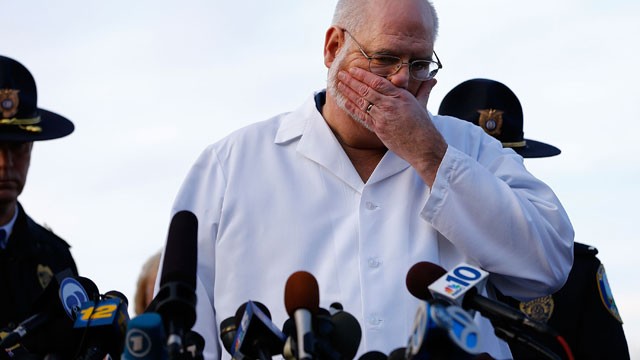
Connecticut Chief Medical Examiner H. Wayne Carver II
Having said something about our responsibility to comfort the mourners, we must expand our view to the entire community, and to the plague of violence which haunts our society. The tragic reframe does not imply passivity, the opposite is true: we must fight the plague with all the powers at our disposal. Whether the solution is more “sword” control, or better services for the ill, we must do everything we can to stop this plague, and we cannot quit until we create a community where lovingkindedness, and not violence, are the rule of the land.
Alongside this subdued comfort, we still hold on to our messianic dreams. When raising a mourner from Shiva, the following verse is said. Messianic in its focus, this verse speaks to the day when the “tragic reframe” can be relinquished, and all plagues will be brought to an end. The time is not nigh, but we continue to work towards it nonetheless, every day:
בִּלַּע הַמָּוֶת לָנֶצַח וּמָחָה אֲדֹנָי ה' דִּמְעָה מֵעַל כָּל פָּנִים
“Death will be vanquished forever, and the Lord God will wipe away the tears from all faces”
(Isaiah 25:8)
May God wipe away tears from all faces, soon. In the meantime, it is up to us.
In memory of Charlotte, Daniel, Olivia, Josephine, Ana, Dylan, Madeline, Catherine, Chase, Jesse, James, Grace, Emilie, Jack, Noah, Caroline, Jessica, Benjamin, Avielle, Allison.

Friday, December 7, 2012

The Origin of Fire: Between Prometheus and the Talmud

Hanukkah 2012 | Rabbi Mishael Zion | Bronfman Fellowships | Text and the City | 

If New York City has a holy of holies, a symbolic heart to the entire project, it is Rockefeller Center’s statue of Prometheus. In shimmering gold he rises, holding the fire stolen from the Gods, while tourists twirl around him on the ice-skating rink. Above the statue a quote from Aeschylus reads: 'Prometheus, teacher in every art, brought the fire that hath proved to mortals a means to mighty ends.'

Prometheus is on my mind this weekend, for on Saturday night many Jews will be performing two of our best fire rituals: Havdalah and Chanukah candle-lighting, raising questions about the meaning and origin of fire in human civilization. In the game of comparative civilizations, the myths about the origin of fire are a telling intersection for the Greek and the Talmudic. Each myth tells a different story not only of our past, but of our modern future as well.

Prometheus was commissioned for the Center’s 1931 opening since he symbolizes the epitome of classical (Protestant) Modernism: a sound belief in the extraordinary powers of Man (to develop science and technology, build skyscrapers, trains, airplanes and bombs), and a hatred of tyrannical Gods (or traditional authority, the Catholic church, the Monarchy). For young Modernists seeking to remove the yoke of a cold and cruel religion that seemed determined to keep them shackled to the past rather than move forward, Prometheus  was the hero, having redeemed humanity from their dependence on God by stealing fire from Zeus. To the Romantic mind, Prometheus was the creator of a new race of people, unafraid to rebel against the Gods, as Goethe describes in his poem, Prometheus, written the same year as the French Revolution:

Shroud your heaven, Zeus,
With cloudy vapours,
And do as you will, like the boy
That beheads thistles,
With oak-trees and mountain-tops;
You must my Earth
Now abandon to me,
And my hut, which you did not build,
And my hearth,
Whose glow
You begrudge me.

I know of nothing poorer
Under the sun, than you, Gods!
You are barely nourished
By sacrificial offerings
And prayerful exhalations
Your Majesty
Would starve, were
Not children and beggars
Hopeful fools.  […]

I should honour you? For what?
Have you softened the sufferings,
Ever, of the burdened?
Have you stilled the tears,
Ever, of the anguished?
Was I not forged as a Man
By almighty Time
And the eternal Fate,
My masters and yours? […]

Here I sit, forming people
In my image;
A race, to be like me,
To suffer, to weep,
To enjoy and delight themselves,
And to mock you –
As I do!
I wonder if Prometheus, watching the millions of Holiday shoppers mill about him at 49thand 5th Avenue, feels pride in the race he formed “to enjoy and delight themselves, and to mock you - as I do!”

The troupe of fire as humanity’s steal, technology being a rebellion against the Gods, is widespread in human civilizations. From the Rig Veda, through Hebrew Apocalyptic texts (in the Book of Enoch the rebellious angel Azazel teaches humans how to make fire) and through to
 Native American tales, the origin of fire is always rooted in theft and in rebellion against God. As a modern Jew and a Zionist, I am deeply indebted to the rebellious spirit of modernism which brought about science, urbanism, Zionism. Indeed, if God is like the God of Goethe and Prometheus, I too would be rebelling.

The Talmud, however, has its own myth about the creation of Fire, and it tells a very different story about God and man. It too begins with God preventing a fire from human beings - that initial light which God created on the first day. Seeing the evil generations that were to reign on his earth in the future, God “concealed it until the future to come,” labeling it the “Or haGanuz”, “Concealed Light”.  But when God took Divine light away, he also presented Humanity with the ability to create our own light:
 

“The Fire” – Rabbi Levi said: The light which was created on the first day of creation served for 36 hours after Adam ate from the tree: from Friday until Saturday night. […] Once Shabbat came out, [the first] darkness began to arrive. Adam became fearful and said: “This is what God said when he cursed me upon eating from the tree – the snake will come and bite me!”
Said Rabbi Levi: At that time God presented Adam with two flints. He struck them together and a fire burst forth. He blessed them saying: בורא מאורי האש – “the creator of fire”.
Shmuel said: Therefor we say the blessing for fire on Motzaei Shabbat – because that is the origin of its creation.

Talmud Yerushalmi, Brachot 8:5
האש - רבי לוי בשם רבי בזירה שלשים ושש שעות שימשה אותה האורה שנבראת ביום הראשון.  שתים עשרה בערב שבת ושתים עשרה בליל שבת ושתים עשרה בשבת.  [...]
כיון שיצאת שבת התחיל משמש החושך ובא ונתירא אדם ואמר אלו הוא שכתב בו (בראשית ג) הוא ישופך ראש ואתה תשופנו עקב שמא בא לנשכני ואמר (תהילים קל) אך חשך ישופני.  אמר רבי לוי באותו שעה זימן הקב"ה שני רעפין והקישן זה לזה ויצא מהן האור הדא הוא דכתיב (שם) ולילה אור בעדני ובירך עליה בורא מאורי האש.  שמואל אמר לפיכך מברכין על האש במוצאי שבתות שהיא תחילת ברייתה.

תלמוד ירושלמי ברכות דף ס,ב פרק ח הלכה ה


This is the tale of the first Motzaei Shabbat, and we re-eanct this drama every time we perform Havdallah. As the “divine light” of Shabbat is taken away from us, and the darkness of mundane time returns, we accept anew the gift of fire.  This gift is described as given by God exactly in order to “still the tears… of the anguished” and to “soften the sufferings of the burdened”. True, God does not shine the “Or haganuz” and redeem the world of all darkness. It might have something to do with His desire to await Humanity overcoming its evil inclinations. But instead of severing ties with the world, God gives us the tools to survive and flourish as we try to mend our ways.

As we come together to light Hanukah candles in the darkest moment of the year, we celebrate this partnership between God and Man, blessing the God who created fire and gave it to us in our hardest moment; God who commanded us to light candles.  As opposed to the Gods of Idolatry, Judaism purports a covenant, an on-going, mutual relationship between the creator and the creatures. We are not in competition, but in cooperation, and God is invested in our technological advancements – as long as they benefit the project of creation. Hanukkah – and the other seasonal festivals of light – come at the darkest time of the year, when we feel most acutely the cold shoulder of this world. It is precisely at this time that we embrace fire – not as a sign of human rebellion but as a sign of the partnership we have with creation (and for some of us, with the Creator). This partnership can be defined thus: When the world is dark, we must shine forth.

One final point: The laws of Hanukkah make it clear that this requirement is not simply an internal act – finding light within ourselves – but rather a responsibility to light the public square: We light Hannukah candles in the window and outside the door, to shine not our own home (in fact, this light cannot be used by us!), but to light the public thoroughfare. In this way, that illustrious tree above Prometheus has it right: in the darkest of months, make the public square shine!

Friday, November 30, 2012

Yaakov and Urban Theory: On Having It All

Rabbi Mishael Zion | Bronfman Fellowships | Text and the City | VaYishlach 2012


A city! It is the grip of man upon nature.
It is a human operation directed against nature, a human organism both for protection and for work.
It is a creation.
   Le Corbusier, The City of Tomorrow and it Planning, 1929

Randomly, in the middle of the parsha, a city suddenly appears. Israelites in the Torah are nomads, shepherds – not city-folk. The city is mentioned only twice before Yaakov, both in unflattering circumstances, yet Yaacov, having made peace with his brother Esav, decides to reside in a city:

And Yaakov came home, whole,
to the city of Shekhem,
Which is in the land of Canaan,
On his homecoming from the country of Aram;
And he encamped facing the city.
(Genesis 33:18)
 וַיָּבֹא יַעֲקֹב שָׁלֵם עִיר שְׁכֶם, אֲשֶׁר בְּאֶרֶץ כְּנַעַן,
בְּבֹאוֹ, מִפַּדַּן אֲרָם;
וַיִּחַן אֶת-פְּנֵי הָעִיר.
בראשית לג:יח

Le Corbusier (1887-1965), Theorist of the Modern City
Living through an age where rapid shifts in technology are changing the way we understand the world and understand ourselves, I find myself returning to that previous era of technological advancement, the Industrial age and the urban revolution. The theorists of the modern city – like Le Corbusier quoted above – capture the experience of modernity that the city created for its inhabitants, a vision that for all our “post-“ness and virtuality many of us still imbibe on a daily basis. In Yaakov I hope to find a role model for someone who lived through the cravings of modernity, and yet was able to redeem them, if for only a brief moment.The manifestos of the Modernist project read much like an entrance into young Yaakov’s psyche. The city suits Yaakov, for his personality is the epitome of the modern city: mobility, efficiency, entrepreneurship, growth and work. Lots of work. Yaakov was always “too big for this town,” rushing to the next achievement. This “forward-looking” vision is captured by Le Corbusier in the following passage, where he contrasts (modern) Man with (medieval) pack-donkey:

Man walks in a straight line because he has a goal and knows where he is going; he has made up his mind to reach some particular place and he goes straight to it.
The pack-donkey meanders along, meditates a little in his scatter-brained and distracted fashion, he zigzags in order to avoid the larger stones, or to ease the climb, or to gain a little shade; he takes the line of least resistance.
Man governs his feelings by his reason; he keeps his feelings and his instincts in check, subordinating them to the aim he has in view. His experience is born of work; man works in order that he may not perish. In order that production may be possible, a line of conduct is essential, the laws of experience must be obeyed. Man must consider the result in advance.
But the pack-donkey thinks of nothing at all, except what will save himself trouble.  
(The City of Tomorrow and it Planning , pg. 6)


Yaakov is purposeful, rational and directed. His brother, Esav, like Le Corbusier’s pack-donkey, is meandering on the path of least resistance in his thuggish “give-me-soup-now” lifestyle. The pack-donkey represents for Le Corbusier the winding alleys of the European medieval town with its unplanned sprawl. Those meandering pathways of the pre-modern age are contrasted with the efficient, congested, forward-looking, over-worked and hyper-planned modern city of Man, with their grids, tunnels and highways. The message is clear: be a man!
When Le Corbusier describes “A city! It is the grip of man upon nature. It is a human operation directed against nature…” the dramatic entrance of baby Yaakov into the world comes to mind: gripping his brother’s heel. From the very moment of his birth he is defying natural order, and thus receives his name: “Yaakov/Heel-Holder”. This is the promise of the city: constant upward mobility, a constant nature-defying rise higher and higher, further uptown and further up to the top floors of the skyscraper. There is always someone to compete with as you attempt to ascend the ladder of success.
But with Yaakov it becomes pathological. He cannot find satisfaction in what he has: be it being second born, or having Leah, or living with Lavan. This happens because he seems to lack an authentic core: there is no “there there”. Yaakov’s essence does not belong to him, but to the person ahead of him, whose heel he is trying to grab. Yaakov’s MO is one of avoidance and manipulation rather than confrontation. He bribes and parries instead of facing the music. Yaakov learns his lesson: Lavan and his daughters teach him a thing or two about trickery and impersonation. But nothing much changes until the night in which Yaakov stops running and scheming and – scared out of his wits from having to confront his brother – Yaakov confronts “a man”. He only has himself, and that is enough. He confronts, until his own leg is held. In that moment, Yaakov receives a new name: “Not as Yaakov/Heel-Sneak shall your name be henceforth uttered, but rather as Yisrael/God-Fighter, for you have fought with God and men and have prevailed.” (Gen. 32:29-30). Having confronted, Yaakov can own his own story.
The proof that Mr. Heel-Sneak found fulfillment comes in contrast to his brother Esav. As they fight about giving eachother gifts and tokens of blessing, these two now wealthy men disclose their own self perception, as the 16th Century Polish Rabbi Shlomo Ephraim of Leczyca, author of the Kli Yakar, explains:

“And Esav said: I have much” – meaning I have much but not all, but Yaakov said: “God has shown me favor – I have all”.
For some people despite having all the gold and silver in the world still feel as if they are lacking, and they have much but are not satisfied, …and others even the small amount in their hand is sufficient and they are happy in their share, feeling that they have all. (Kli Yakar to 33:9)
ויאמר עשו יש לי רב - שמע רב אבל לא כל, ויעקב אמר כי חנני אלהים וכי יש לי כל, לפי שהרשעים אע"פ שיש להם כל כסף וזהב שבעולם מ"מ נראה להם שעדיין הם חסרים, ויש להם רב אבל לא כל צרכם, ...והצדיקים בהפך זה כי אפילו אם יש מעט בידם הם מסתפקים בו ושמחים בחלקם, ונראה כאלו יש להם כל.

I’d suggest that this paradigm shift, from having “much” to attaining “all” is played out in Yaakov’s action in the city of Shechem: he is drawn to the city, but also keeps a distance, remaining "encamped facing the city".
We are a long way away from Le Corbusier’s wide-eyed modernism. The time of mere accumulation as a sign of advancement is gone. We no longer have the privilege of the illusion of “progress”, or even the comfort of the superiority of rational behavior. Many people would give their “all” for the privilege of some meandering. Yet as we live our lives in cities designed according to Le Corbusier’s guidelines, constantly moving from one place to the next, purposeful, productive, achieving, grabbing the heel of the next challenge and moving on up in our search for “much” - we must also work in some distance and perspective. As we ponder how our surroundings shape our self-understanding, we would be wise to make sure we not only take advantage of “the city”, but also take the time to “encamp facing the city”, as Yaakov did. From that encampment we might be able to recall that it is not about the game of “much”, it is about holding on to the “all”, and working from there.

Shabbat Shalom,
Mishael

P.S. This paradigm shift, from having “much” to attaining “all” is played out in Yaakov’s action in the city of Shechem. What actions? While the Torah merely says that he “encamped by the city”, the Talmud, unsatisfied with these parking directions, re-reads this text as a moment of urban leadership. Understanding the term “and he encamped” – ויחן – as referring to חן – grace – the Rabbis re-read Yaakov as giving grace to the city:

"And he showed grace to the city":
Rav said: He established (tikken) coinage for them.
Shmuel said: He established (tikken) markets for them.
Rabbi Yohanan said: He established (tikken) bathhouses for them.­

Talmud Bavli Shabbat 34a (for the context of this quote, in the beloved Talmudic story of Rabbi Shimon Bar Yochai, see below)
"ויחן את פני העיר" –
אמר רב: מטבע תיקן להם.
ושמואל אמר: שווקים תיקן להם.
ורבי יוחנן אמר: מרחצאות תיקן להם.

בבלי שבת לד.

Yaakov is described here as a great urban planner, the establisher of the efficient, safe and clean urban dwelling: currency, commerce and hygiene. Upon arriving at the city of Shekhem, Yaakov embraces his new identity as Yisrael. His shift from “much” to “all” is not a satiated rejection of capitalism, but rather an embrace of regulation. He doesn’t deny the city, rather he seeks to establish in it, establishing being the opposite of pathological competing. He seeks structure, not opportunism. He regulates rather than undermine. He encourages transparency and cleanliness instead of murkiness. These are the actions of one who has “all”.
The midrash about establishing markets and coins becomes a paradigm for “tikkun” in the Talmud. This midrash is quoted in the heart of the Rabbi Shimon Bar Yochai in the Cave story. Two striking aspects to this quote: Yaakov is described as establishing the three things which at the beginning of the story, the Romans are described as doing (with apologies to Monty Python): “How pleasant are the acts of this nation: They established (tiknu) markets! They established bathhouses! They established bridges!” Moreover, when Rabbi Shimon Bar Yochai learns his lesson and leaves the cave, he says: “Since a miracle occurred for me,  I will go and fix some-thing, like our ancestor did,” referring to Yaakov.